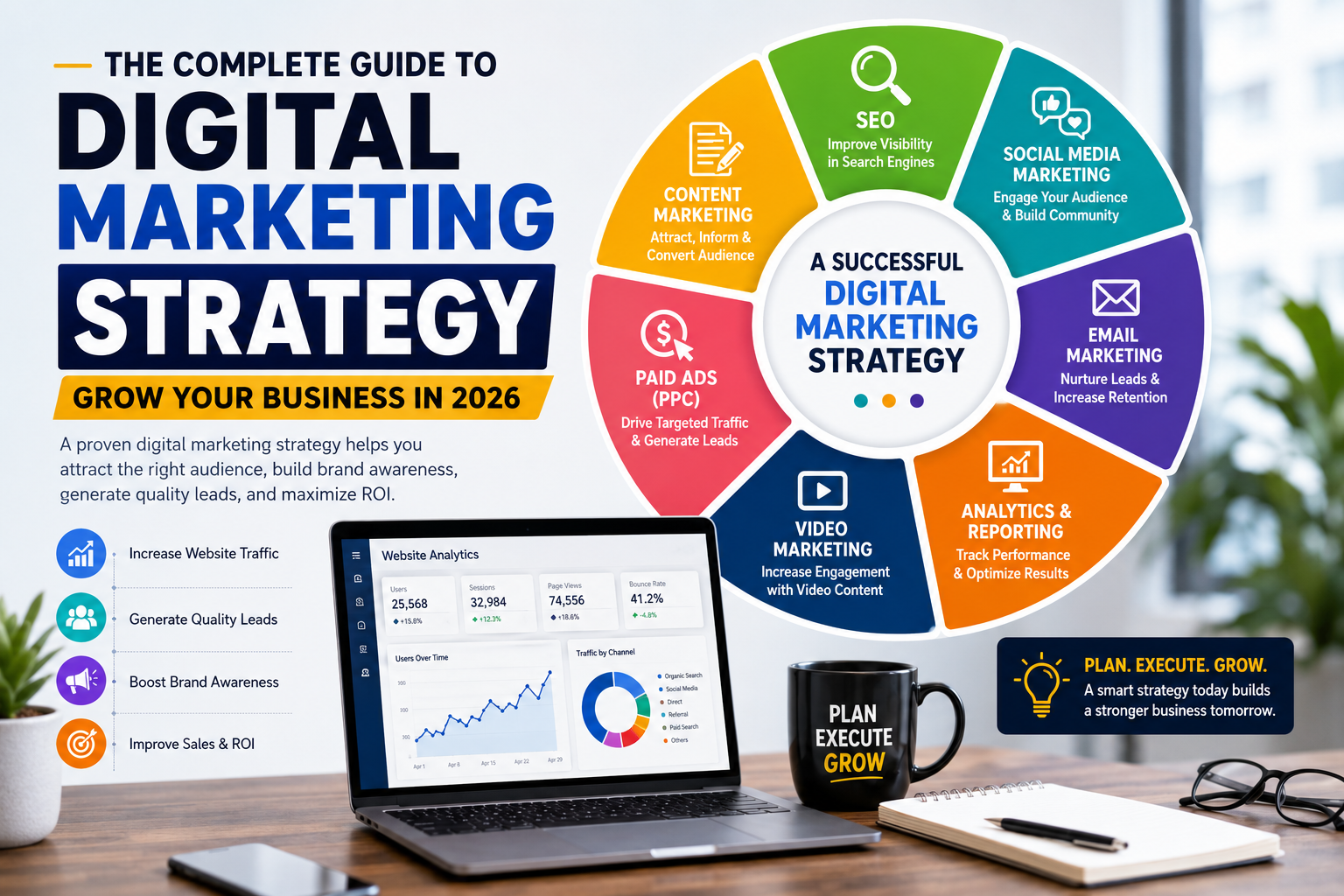

In today’s competitive online world, having a strong Digital Marketing Strategy is essential for businesses of all sizes. Whether you own a startup, an eCommerce store, a local business, or work as a freelancer, the right Digital Marketing Strategy helps you attract customers, build trust, and increase sales.
Many businesses spend money on ads without creating a proper Digital Marketing Strategy, which often leads to poor results. A successful strategy focuses on understanding the target audience, selecting the right marketing channels, creating valuable content, and continuously measuring performance.
If you want long-term business growth, a well-planned Digital Marketing Strategy should be the foundation of your marketing efforts.
What is a Digital Marketing Strategy?
A Digital Marketing Strategy is a step-by-step plan that helps businesses achieve their online marketing goals using digital channels such as search engines, social media, email marketing, content marketing, and paid advertising.
Instead of randomly posting on social media or running advertisements, a strategy ensures that every marketing activity contributes toward a measurable business objective.
An effective Digital Marketing Strategy includes:
- Setting business goals
- Identifying the target audience
- Choosing the right digital channels
- Creating valuable content
- Running paid campaigns
- Measuring results
- Optimizing campaigns regularly
Without a proper strategy, businesses often waste time, money, and resources.
Why is Digital Marketing Strategy Important?
A strong Digital Marketing Strategy provides businesses with a clear roadmap for success. Rather than guessing what might work, companies can make data-driven decisions that improve marketing performance.
Some major benefits include:
Better Brand Awareness
Customers are more likely to trust brands they see consistently across Google, Facebook, Instagram, LinkedIn, and YouTube. A well-planned Digital Marketing Strategy helps maintain a strong online presence.
Higher Website Traffic
SEO, blogging, and content marketing attract visitors who are actively searching for products or services. This makes your Digital Marketing Strategy more effective in generating qualified traffic.
More Qualified Leads
A good strategy targets the right audience instead of everyone. This increases lead quality and improves conversion rates.
Better Return on Investment (ROI)
Every marketing campaign becomes measurable. Businesses can identify what’s working and optimize future campaigns for better performance.
Key Components of a Successful Digital Marketing Strategy
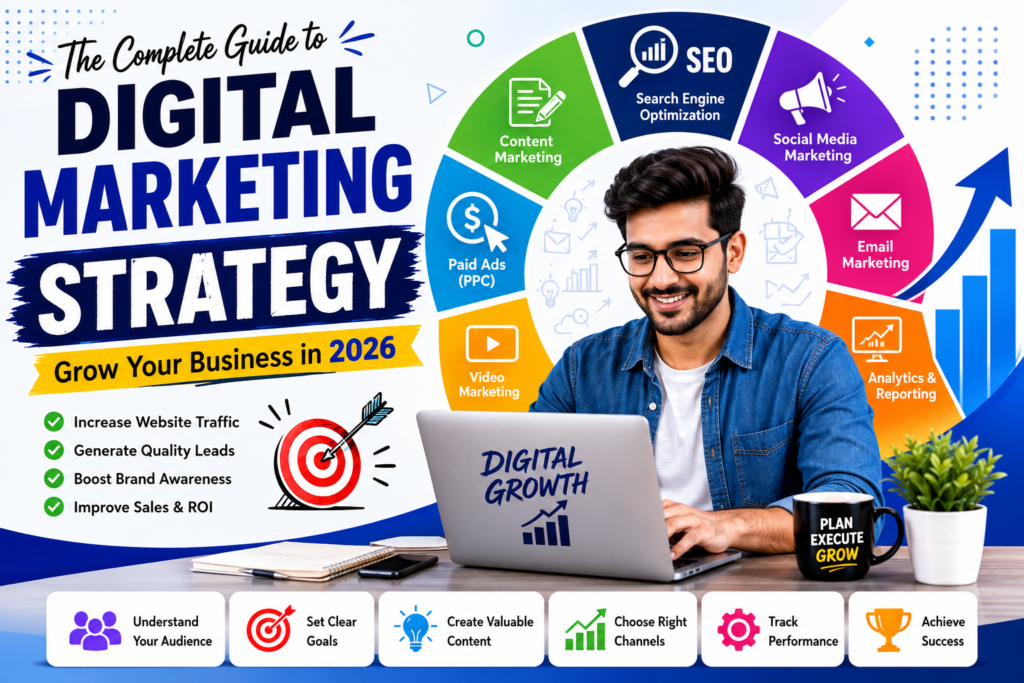
A complete Digital Marketing Strategy consists of several essential components.
1. Search Engine Optimization (SEO)
SEO helps websites rank higher on Google.
Benefits include:
- Organic traffic
- Higher search visibility
- Better credibility
- Long-term growth
- Lower customer acquisition cost
SEO includes:
- Keyword research
- On-page SEO
- Technical SEO
- Link building
- Local SEO
- Content optimization
2. Content Marketing
Content is the heart of every successful Digital Marketing Strategy.
High-quality content helps businesses educate customers, answer questions, and build authority.
Popular content formats include:
- Blog posts
- Videos
- Infographics
- Case studies
- E-books
- Podcasts
- Tutorials
Consistently publishing valuable content also improves SEO performance and drives long-term organic traffic.
3. Social Media Marketing
Social media platforms allow businesses to connect directly with customers.
Popular platforms include:
- YouTube
- X (Twitter)
A strong social media plan supports your overall Digital Marketing Strategy by increasing engagement and brand visibility.
4. Email Marketing
Email marketing remains one of the highest ROI digital marketing channels.
Businesses use email to:
- Welcome new subscribers
- Share newsletters
- Promote products
- Recover abandoned carts
- Build customer loyalty
Email campaigns work best when personalized and targeted.
5. Search Engine Marketing (SEM)
A successful Digital Marketing Strategy often combines organic marketing with paid advertising. Search Engine Marketing (SEM) allows businesses to appear at the top of search engine results instantly through paid ads.
Unlike SEO, which takes time to show results, SEM provides immediate visibility. Businesses can target users based on keywords, location, device, demographics, and search intent.
Benefits of SEM
- Instant website traffic
- Higher visibility on search engines
- Better lead generation
- Flexible budget control
- Measurable campaign performance
- Improved conversion opportunities
When combined with SEO, SEM creates a balanced Digital Marketing Strategy that delivers both short-term and long-term business growth.
6. Pay-Per-Click (PPC) Advertising
PPC advertising is an important part of any modern Digital Marketing Strategy. In PPC campaigns, advertisers only pay when someone clicks on their advertisement.
Popular PPC platforms include:
- Google Ads
- Microsoft Ads
- Facebook Ads
- Instagram Ads
- LinkedIn Ads
- YouTube Ads
Advantages of PPC
- Quick lead generation
- Highly targeted audience
- Budget flexibility
- Real-time performance tracking
- Better return on investment with optimization
A well-managed PPC campaign can significantly improve the effectiveness of your Digital Marketing Strategy by driving high-intent visitors to your website.
7. Social Media Advertising
Organic social media is valuable, but paid social advertising helps businesses reach a much larger audience.
A strong Digital Marketing Strategy uses social media ads to:
- Increase brand awareness
- Generate leads
- Drive website traffic
- Promote products and services
- Retarget previous visitors
- Improve customer engagement
Each platform offers different targeting options, allowing businesses to reach the right audience based on interests, age, behavior, location, and purchasing habits.
8. Video Marketing
Video content has become one of the most powerful tools in any Digital Marketing Strategy. People prefer watching videos because they are engaging, informative, and easy to consume.
Businesses can use video marketing for:
- Product demonstrations
- Customer testimonials
- Educational tutorials
- Behind-the-scenes content
- Live streaming
- Brand storytelling
- Frequently Asked Questions
Short-form videos are especially effective for increasing engagement and attracting new audiences.
A consistent video marketing plan strengthens your overall Digital Marketing Strategy by improving customer trust and increasing conversion rates.
9. Influencer Marketing
Influencer marketing has become an effective way to build credibility and reach targeted audiences.
Instead of promoting products directly, businesses collaborate with influencers who already have loyal followers.
Benefits include:
- Higher brand trust
- Increased reach
- Better engagement
- Improved conversions
- Authentic recommendations
Choosing influencers whose audience matches your business goals makes your Digital Marketing Strategy more effective.
10. Affiliate Marketing
Affiliate marketing allows businesses to partner with individuals or publishers who promote products in exchange for a commission.
This approach helps businesses expand their reach without significant upfront advertising costs.
Advantages include:
- Performance-based marketing
- Low investment
- Increased sales
- Better brand exposure
- Scalable growth opportunities
Affiliate marketing works particularly well for eCommerce businesses looking to strengthen their Digital Marketing Strategy.
How to Create an Effective Digital Marketing Strategy
Developing a successful Digital Marketing Strategy requires careful planning and continuous optimization.
Step 1: Define Your Goals
Start by identifying what you want to achieve.
Examples include:
- Increase website traffic
- Generate more leads
- Improve online sales
- Build brand awareness
- Increase customer retention
Clear goals help measure the success of your Digital Marketing Strategy.
Step 2: Understand Your Target Audience
Knowing your audience is essential.
Research factors such as:
- Age
- Gender
- Location
- Interests
- Occupation
- Income
- Online behavior
- Pain points
Understanding customer needs allows businesses to create more relevant marketing campaigns.
Step 3: Conduct Competitor Research
Analyze your competitors to discover:
- Their SEO strategy
- Social media activity
- Advertising methods
- Content quality
- Website performance
- Customer engagement
Competitor analysis helps improve your own Digital Marketing Strategy by identifying opportunities and avoiding common mistakes.
Step 4: Choose the Right Marketing Channels
Not every platform is suitable for every business.
Choose channels based on your audience and objectives.
Examples include:
- SEO for long-term organic growth
- Google Ads for immediate traffic
- Social media for engagement
- Email marketing for customer retention
- Content marketing for authority building
- Video marketing for higher engagement
Selecting the right channels ensures your Digital Marketing Strategy delivers better results.
5. Search Engine Marketing (SEM)
A successful Digital Marketing Strategy often combines organic marketing with paid advertising. Search Engine Marketing (SEM) allows businesses to appear at the top of search engine results instantly through paid ads.
Unlike SEO, which takes time to show results, SEM provides immediate visibility. Businesses can target users based on keywords, location, device, demographics, and search intent.
Benefits of SEM
- Instant website traffic
- Higher visibility on search engines
- Better lead generation
- Flexible budget control
- Measurable campaign performance
- Improved conversion opportunities
When combined with SEO, SEM creates a balanced Digital Marketing Strategy that delivers both short-term and long-term business growth.
6. Pay-Per-Click (PPC) Advertising
PPC advertising is an important part of any modern Digital Marketing Strategy. In PPC campaigns, advertisers only pay when someone clicks on their advertisement.
Popular PPC platforms include:
- Google Ads
- Microsoft Ads
- Facebook Ads
- Instagram Ads
- LinkedIn Ads
- YouTube Ads
Advantages of PPC
- Quick lead generation
- Highly targeted audience
- Budget flexibility
- Real-time performance tracking
- Better return on investment with optimization
A well-managed PPC campaign can significantly improve the effectiveness of your Digital Marketing Strategy by driving high-intent visitors to your website.
7. Social Media Advertising
Organic social media is valuable, but paid social advertising helps businesses reach a much larger audience.
A strong Digital Marketing Strategy uses social media ads to:
- Increase brand awareness
- Generate leads
- Drive website traffic
- Promote products and services
- Retarget previous visitors
- Improve customer engagement
Each platform offers different targeting options, allowing businesses to reach the right audience based on interests, age, behavior, location, and purchasing habits.
8. Video Marketing
Video content has become one of the most powerful tools in any Digital Marketing Strategy. People prefer watching videos because they are engaging, informative, and easy to consume.
Businesses can use video marketing for:
- Product demonstrations
- Customer testimonials
- Educational tutorials
- Behind-the-scenes content
- Live streaming
- Brand storytelling
- Frequently Asked Questions
Short-form videos are especially effective for increasing engagement and attracting new audiences.
A consistent video marketing plan strengthens your overall Digital Marketing Strategy by improving customer trust and increasing conversion rates.
9. Influencer Marketing
Influencer marketing has become an effective way to build credibility and reach targeted audiences.
Instead of promoting products directly, businesses collaborate with influencers who already have loyal followers.
Benefits include:
- Higher brand trust
- Increased reach
- Better engagement
- Improved conversions
- Authentic recommendations
Choosing influencers whose audience matches your business goals makes your Digital Marketing Strategy more effective.
10. Affiliate Marketing
Affiliate marketing allows businesses to partner with individuals or publishers who promote products in exchange for a commission.
This approach helps businesses expand their reach without significant upfront advertising costs.
Advantages include:
- Performance-based marketing
- Low investment
- Increased sales
- Better brand exposure
- Scalable growth opportunities
Affiliate marketing works particularly well for eCommerce businesses looking to strengthen their Digital Marketing Strategy.
How to Create an Effective Digital Marketing Strategy
Developing a successful Digital Marketing Strategy requires careful planning and continuous optimization.
Step 1: Define Your Goals
Start by identifying what you want to achieve.
Examples include:
- Increase website traffic
- Generate more leads
- Improve online sales
- Build brand awareness
- Increase customer retention
Clear goals help measure the success of your Digital Marketing Strategy.
Step 2: Understand Your Target Audience
Knowing your audience is essential.
Research factors such as:
- Age
- Gender
- Location
- Interests
- Occupation
- Income
- Online behavior
- Pain points
Understanding customer needs allows businesses to create more relevant marketing campaigns.
Step 3: Conduct Competitor Research
Analyze your competitors to discover:
- Their SEO strategy
- Social media activity
- Advertising methods
- Content quality
- Website performance
- Customer engagement
Competitor analysis helps improve your own Digital Marketing Strategy by identifying opportunities and avoiding common mistakes.
Step 4: Choose the Right Marketing Channels
Not every platform is suitable for every business.
Choose channels based on your audience and objectives.
Examples include:
- SEO for long-term organic growth
- Google Ads for immediate traffic
- Social media for engagement
- Email marketing for customer retention
- Content marketing for authority building
- Video marketing for higher engagement
Selecting the right channels ensures your Digital Marketing Strategy delivers better results.https://ayusshdigital.online/
Step 5: Create Valuable Content
Content remains one of the strongest pillars of a successful Digital Marketing Strategy.
Focus on creating:
- Helpful blog posts
- Educational videos
- Infographics
- Case studies
- Guides
- Checklists
- FAQs
High-quality content answers users’ questions, builds trust, and improves search engine rankings.
AI in Digital Marketing
Artificial Intelligence (AI) is transforming how businesses connect with customers. Integrating AI into your Digital Marketing Strategy can improve efficiency, personalize customer experiences, and automate repetitive tasks.
AI helps marketers analyze large amounts of data, predict customer behavior, and optimize campaigns in real time.
Benefits of AI in Digital Marketing
- Personalized customer experiences
- Faster data analysis
- Improved customer support with chatbots
- Better audience targeting
- Predictive analytics
- Higher campaign efficiency
Businesses that adopt AI as part of their Digital Marketing Strategy gain a competitive advantage by making smarter, data-driven decisions.
Marketing Automation
Marketing automation allows businesses to streamline repetitive marketing tasks, saving time while improving customer engagement.
Common automated activities include:
- Welcome email sequences
- Lead nurturing campaigns
- Social media scheduling
- Customer follow-ups
- Cart abandonment emails
- CRM updates
Automation ensures consistency and helps businesses scale their Digital Marketing Strategy without increasing manual effort.
Website Optimization
Your website is the foundation of every Digital Marketing Strategy. Even the best marketing campaigns may fail if visitors have a poor experience on your website.
Best Practices for Website Optimization
- Improve page loading speed
- Make the website mobile-friendly
- Use clear navigation
- Optimize images
- Add strong calls-to-action (CTAs)
- Improve website security (HTTPS)
- Ensure easy contact options
A fast, user-friendly website keeps visitors engaged and increases the chances of converting them into customers.
Measuring Performance with Analytics
No Digital Marketing Strategy is complete without tracking results. Analytics help businesses understand what is working and where improvements are needed.
Regular performance reviews allow marketers to make informed decisions instead of relying on guesswork.
Important Metrics to Track
- Website traffic
- Organic search performance
- Bounce rate
- Conversion rate
- Click-Through Rate (CTR)
- Cost Per Click (CPC)
- Cost Per Acquisition (CPA)
- Return on Investment (ROI)
- Average session duration
- Customer Lifetime Value (CLV)
Monitoring these KPIs helps refine your Digital Marketing Strategy over time.
Best Tools for Digital Marketing
Using the right tools can make your Digital Marketing Strategy more efficient and data-driven.
SEO Tools
- Google Search Console
- Google Keyword Planner
- Ahrefs
- SEMrush
- Ubersuggest
Analytics Tools
- Google Analytics
- Looker Studio
- Hotjar
Social Media Tools
- Buffer
- Hootsuite
- Meta Business Suite
Email Marketing Tools
- Mailchimp
- Brevo
- ConvertKit
Design Tools
- Canva
- Adobe Express
Choosing tools that align with your business goals improves productivity and campaign performance.
Common Digital Marketing Mistakes to Avoid
Even experienced marketers can make mistakes. Avoiding these common errors will strengthen your Digital Marketing Strategy.
Ignoring SEO
Without SEO, your website may struggle to gain organic visibility, limiting long-term growth.
Not Understanding Your Audience
Marketing to everyone often means connecting with no one. Research your audience thoroughly before launching campaigns.
Inconsistent Branding
Using different logos, colors, or messaging across platforms can confuse customers. Maintain a consistent brand identity.
Publishing Low-Quality Content
Content should provide value, answer user questions, and solve real problems. Thin or duplicate content can hurt both user trust and search rankings.
Forgetting Mobile Users
A significant portion of users browse on mobile devices. Ensure your website and campaigns are optimized for smaller screens.
Ignoring Data
Making decisions without analyzing campaign data can waste time and budget. Regularly review performance metrics to improve your Digital Marketing Strategy.
Digital Marketing Trends for 2026
The digital landscape continues to evolve. Staying updated with trends helps businesses remain competitive.
AI-Powered Personalization
Customers increasingly expect personalized recommendations and experiences.
Voice Search Optimization
As voice assistants become more common, optimizing content for conversational search queries is becoming more important.
Short-Form Video Content
Platforms featuring short videos continue to attract high engagement, making this format valuable for brand awareness.
Privacy-Focused Marketing
With growing privacy regulations, businesses should prioritize transparent data collection and first-party data strategies.
Local SEO
Businesses serving specific geographic areas should optimize for local searches to attract nearby customers.
Interactive Content
Quizzes, polls, calculators, and interactive tools encourage user engagement and can increase time spent on your website.
Adapting to these trends will help future-proof your Digital Marketing Strategy.
Key Takeaways
A successful Digital Marketing Strategy is not built overnight. It requires planning, consistent execution, continuous learning, and regular optimization.
By combining SEO, content marketing, social media, paid advertising, email marketing, AI, analytics, and website optimization, businesses can build a sustainable online presence and achieve long-term growth.Home
Frequently Asked Questions (FAQs)
1. What is a Digital Marketing Strategy?
A Digital Marketing Strategy is a structured plan that helps businesses achieve their online marketing goals using channels such as SEO, content marketing, social media, email marketing, and paid advertising. A well-planned strategy ensures that every marketing effort supports business growth.
2. Why is a Digital Marketing Strategy important?
A strong Digital Marketing Strategy helps businesses attract the right audience, improve brand awareness, generate quality leads, increase website traffic, and maximize return on investment (ROI). It also helps allocate marketing budgets more effectively.
3. What are the key components of a Digital Marketing Strategy?
A successful Digital Marketing Strategy typically includes:
- Search Engine Optimization (SEO)
- Content Marketing
- Social Media Marketing
- Email Marketing
- Pay-Per-Click (PPC) Advertising
- Video Marketing
- Marketing Automation
- Website Optimization
- Analytics and Performance Tracking
Together, these elements create a comprehensive approach to online growth.
4. How long does it take for a Digital Marketing Strategy to show results?
The timeline depends on the marketing channel. SEO and content marketing usually take several months to build momentum, while PPC advertising can deliver traffic almost immediately. A balanced Digital Marketing Strategy often combines both short-term and long-term tactics.
5. Is Digital Marketing Strategy suitable for small businesses?
Yes. A Digital Marketing Strategy is valuable for businesses of every size. Small businesses can use targeted SEO, local marketing, content creation, and social media to compete effectively, even with limited budgets.
6. How often should a Digital Marketing Strategy be updated?
Your Digital Marketing Strategy should be reviewed regularly—at least every quarter. Monitor performance data, industry trends, customer behavior, and competitor activities to make informed adjustments.
Final Conclusion
In today’s competitive digital landscape, a well-designed Digital Marketing Strategy is essential for sustainable business growth. Whether your goal is to increase website traffic, generate leads, build brand awareness, or improve customer loyalty, having a structured plan is the key to long-term success.
A complete Digital Marketing Strategy combines SEO, content marketing, social media, paid advertising, email campaigns, AI-driven insights, analytics, and continuous optimization. Rather than relying on isolated tactics, businesses should ensure that all digital channels work together toward common objectives.
Remember that digital marketing is an ongoing process. Search engine algorithms evolve, customer preferences change, and new technologies emerge. By consistently analyzing results, refining campaigns, and delivering valuable content, businesses can stay competitive and achieve measurable growth.
If you are just starting, focus on understanding your audience, creating high-quality content, and building a strong online presence. Over time, your Digital Marketing Strategy will become more effective as you gain data, experience, and customer insights.
Invest in learning, adapt to change, and keep testing new ideas. A thoughtful and data-driven Digital Marketing Strategy will not only help your business succeed in 2026 but also prepare it for future opportunities.