
Introduction
The e-commerce industry continues to grow rapidly, making online competition tougher than ever. Thousands of new online stores are launched every day, and customers have endless options when searching for products. Without proper search engine optimization, even high-quality products can remain invisible to potential buyers.
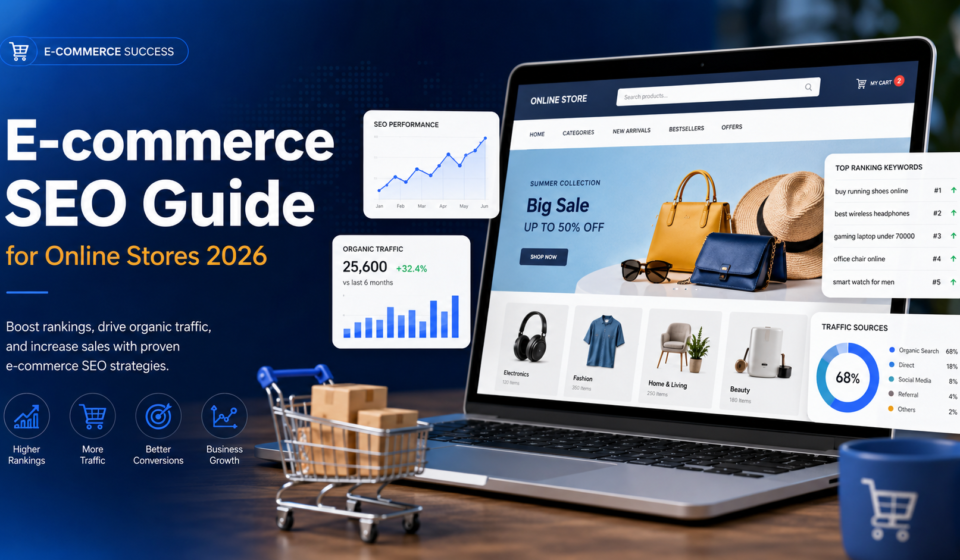
A well-planned E-commerce SEO Guide helps online stores improve their visibility in search engines, attract targeted visitors, and increase sales without depending entirely on paid advertising. Unlike paid ads, SEO provides long-term benefits by continuously bringing organic traffic to your website.
Whether you own a Shopify, WooCommerce, Magento, BigCommerce, or custom-built online store, implementing the right SEO strategies can significantly improve your rankings on Google and other search engines.
In this complete E-commerce SEO Guide, you’ll learn proven strategies to optimize every aspect of your online store—from keyword research and product page optimization to technical SEO and advanced ranking techniques.
If your goal is to increase organic traffic, improve user experience, and boost conversions, this guide is for you.Contact Us
What is E-commerce SEO?
E-commerce SEO is the process of optimizing an online store so that its product pages, category pages, and website content rank higher in search engine results.
The primary objective of E-commerce SEO is to help customers discover your products when they search for relevant keywords on Google.
For example, if someone searches for:
- Best Wireless Earbuds
- Men’s Running Shoes
- Buy Office Chair Online
- Gaming Laptop Under ₹70,000
Google displays the most relevant online stores based on hundreds of ranking factors.
Following a professional E-commerce SEO Guide helps ensure your store appears among those top search results.
Why is E-commerce SEO Important?
Many online businesses spend thousands of rupees every month on paid advertising. While ads can generate quick traffic, they stop delivering results as soon as the budget ends.
SEO, on the other hand, provides sustainable growth.
Here are the biggest benefits of E-commerce SEO:
1. Increase Organic Traffic
SEO helps your products appear when customers actively search for them.
Instead of paying for every click, you receive consistent visitors from search engines.
2. Higher Sales
People searching on Google usually have buying intent.
This means they’re more likely to purchase compared to users who randomly see advertisements.
3. Lower Marketing Costs
Although SEO requires time and effort, it reduces long-term customer acquisition costs.
Organic traffic continues even after optimization work is completed.
4. Better User Experience
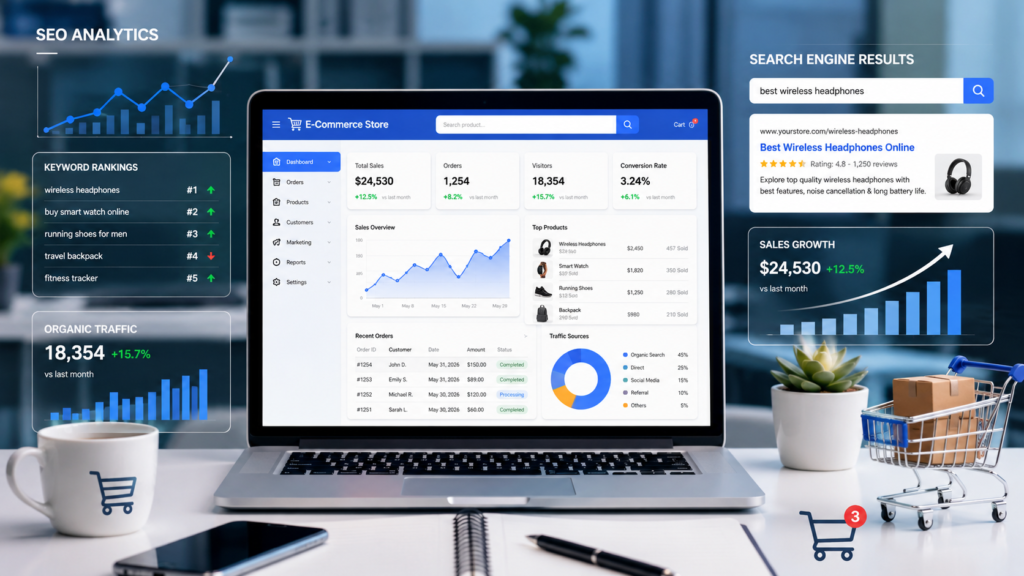
Search engines reward websites that are fast, mobile-friendly, secure, and easy to navigate.
Improving SEO also improves customer satisfaction.
5. Build Brand Authority
Websites that consistently rank on the first page of Google naturally earn more trust.
Customers often associate higher rankings with higher credibility.
How Search Engines Rank Online Stores
Google uses hundreds of ranking signals to determine which online stores deserve top positions.
Some of the most important ranking factors include:
Website Quality
Google evaluates your website’s design, speed, security, and overall user experience.
Content Quality
Unique and informative product descriptions perform better than copied manufacturer content.
Google prefers original content that genuinely helps users.
Keyword Relevance
Your pages should naturally include keywords that customers actually search for.
Proper keyword placement helps search engines understand your content.
Backlinks
When trusted websites link to your store, Google sees your website as more authoritative.
High-quality backlinks remain one of the strongest ranking factors.
User Experience
Google measures how users interact with your website.
Factors include:
- Bounce Rate
- Time on Site
- Navigation
- Mobile Friendliness
- Page Speed
Positive user signals often contribute to better rankings.
E-commerce SEO vs Traditional SEO
Although both aim to improve search rankings, there are important differences.
| E-commerce SEO | Traditional SEO |
|---|---|
| Focuses on product and category pages | Focuses mainly on informational pages |
| Optimizes product listings | Optimizes blog articles and service pages |
| Targets buyers | Targets readers and researchers |
| Prioritizes conversions | Prioritizes traffic and engagement |
| Uses product schema | Uses article schema |
An effective E-commerce SEO Guide combines both approaches by optimizing products while also publishing helpful content.
Essential SEO Elements for Every Online Store
Successful online stores optimize every part of their website.
These include:
Homepage SEO
The homepage should clearly explain:
- What your business sells
- Your unique selling points
- Product categories
- Trust signals
- Contact information
Category Page SEO
Category pages help users browse related products.
Examples:
- Men’s Shoes
- Women’s Clothing
- Mobile Accessories
- Home Furniture
Well-optimized category pages often rank for high-volume keywords.
Product Page SEO
Every product page should include:
- Unique product title
- Detailed description
- High-quality images
- Product specifications
- Customer reviews
- FAQ section
- Related products
These elements improve both rankings and conversions.
Blog Content
Publishing useful blog posts attracts visitors earlier in the buying journey.
Examples include:
- Buying Guides
- Product Comparisons
- How-To Articles
- Industry Trends
- Product Reviews
A blog also creates opportunities to link naturally to your product pages.
Common E-commerce SEO Mistakes
Many online stores lose rankings because of avoidable errors.
Here are some of the most common mistakes:
Copying Product Descriptions
Using manufacturer descriptions creates duplicate content.
Always write original product descriptions.
Poor Website Navigation
Complicated menus make it difficult for both users and search engines to find products.
Keep navigation simple and organized.
Ignoring Mobile Users
More than half of e-commerce traffic comes from mobile devices.
Your website should provide a smooth experience on smartphones and tablets.
Slow Website Speed
Slow-loading pages increase bounce rates and reduce conversions.
Optimize images, hosting, and code for better performance.
Missing Meta Titles
Every important page should have a unique SEO title and meta description.
This improves click-through rates from search results.
Broken Links
Broken internal or external links create a poor user experience.
Regularly check your website for broken links and fix them.
Ignoring Customer Reviews
Reviews build trust and often improve search visibility.
Encourage customers to leave genuine feedback after purchases.
Benefits of Following This E-commerce SEO Guide
By implementing the strategies covered in this guide, you can:
- Increase organic traffic
- Improve Google rankings
- Reduce advertising costs
- Generate more qualified visitors
- Increase product sales
- Build customer trust
- Improve website usability
- Stay ahead of competitors
- Create long-term business growth
SEO is a long-term investment, but the rewards compound over time.
Keyword Research for E-commerce SEO
Keyword research is the foundation of every successful E-commerce SEO Guide. Without targeting the right keywords, even a beautifully designed online store may struggle to attract the right customers.
The goal is to identify the exact search terms your potential customers use when looking for products like yours.
For example, instead of targeting a broad keyword like:
Shoes
Target more specific keywords such as:
- Buy Running Shoes Online
- Men’s Sports Shoes
- Women’s Sneakers Under ₹2,000
- Best Running Shoes for Beginners
Long-tail keywords usually have less competition and higher conversion rates because they match specific buying intent.
Types of E-commerce Keywords
Understanding keyword intent helps you create pages that match what users are searching for.
1. Informational Keywords
Users want information before making a purchase.
Examples:
- How to choose a gaming laptop
- Best DSLR Camera Guide
- Laptop Buying Guide
- Difference Between SSD and HDD
These keywords are ideal for blog posts.
2. Commercial Keywords
Users are comparing products before buying.
Examples:
- Best Wireless Earbuds
- Best Budget Smartphone
- Top Office Chair
- Best Smart Watch Under ₹5,000
These keywords attract users close to making a purchase.
3. Transactional Keywords
These users are ready to buy.
Examples:
- Buy Bluetooth Speaker Online
- Order Office Chair
- Buy iPhone Online India
- Buy Gaming Monitor
These keywords should be targeted on product pages.
4. Branded Keywords
Users search using brand names.
Examples:
- Nike Running Shoes
- Samsung Smart TV
- Apple AirPods
- Dell Laptop
Branded searches often have high conversion rates.
Best Tools for Keyword Research
Here are some reliable tools for finding profitable keywords:
- Google Keyword Planner
- Google Search Console
- Google Autocomplete
- Google Trends
- Ahrefs
- SEMrush
- Ubersuggest
- KeywordTool.io
- AnswerThePublic
These tools help identify search volume, competition, and related keyword opportunities.
Optimize Category Pages
Category pages are among the most valuable pages on an e-commerce website. They often target broad keywords with high search volume.
Example Categories
- Men’s Clothing
- Women’s Footwear
- Kitchen Appliances
- Mobile Accessories
- Home Furniture
- Beauty Products
Each category page should include:
- Unique SEO title
- Optimized meta description
- Keyword-rich heading
- Introductory content (150–300 words)
- High-quality images
- Internal links to subcategories and products
Avoid creating thin category pages with only product listings.
Product Page SEO
Every product page should be fully optimized to improve rankings and encourage conversions.
Write Unique Product Titles
Avoid generic titles.
❌ Wireless Earbuds
✅ Noise-Cancelling Wireless Bluetooth Earbuds with 40-Hour Battery Life
Clear, descriptive titles help both users and search engines understand the product.
Write Original Product Descriptions
Never copy manufacturer descriptions.
Instead, explain:
- Key features
- Benefits
- Product specifications
- Usage tips
- Warranty information
- Care instructions (if applicable)
Unique descriptions improve SEO and build customer confidence.
Use Bullet Points
Many shoppers scan pages rather than reading every word.
Highlight key information with bullet points.
Example:
Features
- Bluetooth 5.3
- 40-Hour Battery Backup
- Fast Charging
- IPX5 Water Resistant
- Built-in Noise Cancellation
- One-Touch Controls
This improves readability and user experience.
Optimize Product Images
Images play an important role in both SEO and conversions.
Best Practices
- Upload high-resolution images.
- Compress files to reduce loading time.
- Use descriptive file names.
- Add keyword-rich ALT text.
- Show multiple product angles.
- Include zoom functionality.
Example:
File Name:
wireless-bluetooth-earbuds-black.webp
ALT Text:
“Wireless Bluetooth Earbuds with Noise Cancellation”
Add Customer Reviews
Reviews increase trust and provide fresh user-generated content, which search engines value.
Benefits include:
- Higher credibility
- Better conversion rates
- Increased keyword relevance
- Improved click-through rates
Encourage verified customers to leave honest reviews after every purchase.
Optimize Product URLs
URLs should be short, clean, and descriptive.
Good Example
yourstore.com/wireless-bluetooth-earbuds
Bad Example
yourstore.com/product?id=45678&ref=abc
SEO-friendly URLs improve usability and make it easier for search engines to understand your pages.
Write SEO-Friendly Title Tags
Your title tag is one of the most important on-page SEO elements.
Example
Wireless Bluetooth Earbuds | 40-Hour Battery | Digital Rohit Store
Best practices:
- Keep titles under 60 characters.
- Include the primary keyword.
- Add your brand name when appropriate.
- Make the title compelling to improve click-through rates.
Write High-Converting Meta Descriptions
A meta description encourages users to click your listing in search results.
Example
Buy premium wireless Bluetooth earbuds with advanced noise cancellation, 40-hour battery life, and fast delivery. Shop now at Digital Rohit Store.
Keep meta descriptions between 150–160 characters and include a clear call to action.
Use Proper Heading Structure
Organize every product page with a logical heading hierarchy.
Example
H1
Wireless Bluetooth Earbuds
H2
Product Features
H2
Technical Specifications
H2
Customer Reviews
H2
Frequently Asked Questions
This structure improves readability and helps search engines understand your content.
Internal Linking Strategy
Internal links help distribute authority across your website and make navigation easier.
Link products to:
- Related products
- Similar categories
- Buying guides
- Blog articles
- Best-selling products
- Accessories
Example:
If you sell smartphones, link to:
- Phone Cases
- Screen Protectors
- Chargers
- Wireless Earbuds
This increases page views and encourages additional purchases.
Use Breadcrumb Navigation
Breadcrumbs show users where they are within your website.
Example:
Home > Electronics > Audio > Wireless Earbuds
Benefits:
- Easier navigation
- Better user experience
- Improved internal linking
- Enhanced search engine understanding
Optimize for Rich Snippets
Rich snippets make your listings more attractive in search results.
Include structured data for:
- Product name
- Price
- Availability
- Ratings
- Reviews
- Brand
Rich snippets can improve visibility and click-through rates.
Common On-Page SEO Mistakes
Avoid these common mistakes:
- Duplicate product descriptions
- Missing ALT text for images
- Overusing keywords (keyword stuffing)
- Thin category pages
- Long, confusing URLs
- Missing internal links
- Poor-quality images
- Generic title tags
- Duplicate meta descriptions
Fixing these issues can significantly improve your search performance.
Technical SEO for E-commerce Websites
A successful E-commerce SEO Guide isn’t just about adding keywords to product pages. Technical SEO ensures that search engines can crawl, index, and rank your online store efficiently. Without strong technical optimization, even high-quality content may struggle to rank.
Technical SEO improves website performance, user experience, and overall search visibility, making it a vital part of every E-commerce SEO Guide.
Improve Website Speed
Website speed is one of Google’s ranking factors and directly impacts conversions. Studies show that users often leave a website if it takes more than a few seconds to load.
Ways to Improve Website Speed
- Compress images before uploading.
- Use WebP image format.
- Enable browser caching.
- Minify CSS, JavaScript, and HTML files.
- Use a reliable hosting provider.
- Implement a Content Delivery Network (CDN).
- Remove unnecessary plugins and scripts.
- Enable lazy loading for images.
A faster website not only improves rankings but also enhances the shopping experience. Every E-commerce SEO Guide should prioritize speed optimization.
Mobile SEO for Online Stores
Most online shoppers now browse and purchase products using smartphones. Google also uses mobile-first indexing, meaning it primarily evaluates the mobile version of your website.
Mobile SEO Checklist
- Responsive website design
- Fast loading pages
- Easy-to-click buttons
- Readable fonts
- Simple navigation
- Mobile-friendly checkout process
- Optimized images
- Minimal pop-ups
A mobile-friendly website is an essential recommendation in every E-commerce SEO Guide because it improves both rankings and conversions.
XML Sitemap
An XML sitemap helps search engines discover and index your important pages quickly.
Include:
- Homepage
- Category Pages
- Product Pages
- Blog Posts
- Important Landing Pages
Update your sitemap automatically whenever new products or categories are added. This simple step strengthens your E-commerce SEO Guide by ensuring search engines always have the latest version of your site.
Optimize Robots.txt
The robots.txt file tells search engines which pages should and should not be crawled.
Allow indexing for:
- Product pages
- Category pages
- Blog posts
Block unnecessary pages such as:
- Admin pages
- Login pages
- Cart pages
- Checkout pages
- Internal search results
A properly configured robots.txt file is another technical element of a complete E-commerce SEO Guide.
Use Canonical Tags
Duplicate content is common in online stores because products may appear in multiple categories or have different filter URLs.
Canonical tags tell search engines which version of a page should be treated as the original.
Benefits include:
- Prevent duplicate content issues
- Consolidate ranking signals
- Improve crawl efficiency
Canonical tags are a must-have in every professional E-commerce SEO Guide.
Add Product Schema Markup
Structured data (Schema Markup) helps search engines understand your products and display rich results in search.
Use Product Schema to show:
- Product Name
- Price
- Availability
- Ratings
- Reviews
- Brand
- SKU
Rich snippets can improve click-through rates and increase visibility, making schema an important part of an E-commerce SEO Guide.
Prevent Duplicate Content
Duplicate content can reduce your search performance.
Avoid:
- Copying manufacturer descriptions
- Publishing identical category content
- Using multiple URLs for the same product
- Creating duplicate meta titles and descriptions
Instead:
- Write unique product descriptions.
- Use canonical tags.
- Create original category introductions.
- Regularly audit your content.
Preventing duplicate content is a key recommendation in any E-commerce SEO Guide.
Link Building for E-commerce SEO
Backlinks remain one of the strongest ranking signals. High-quality links from trusted websites improve your online store’s authority.
Effective Link Building Strategies
- Guest posting
- Product reviews by bloggers
- Influencer collaborations
- Digital PR
- Business directories
- Resource page outreach
- Creating shareable content
- Publishing industry research
Avoid buying backlinks or participating in link schemes, as these can harm your rankings. Ethical link building is always recommended in an E-commerce SEO Guide.
Content Marketing for Online Stores
Content marketing helps attract customers at different stages of the buying journey.
Create content such as:
- Buying Guides
- Product Comparisons
- How-To Articles
- FAQs
- Product Tutorials
- Industry News
- Seasonal Shopping Guides
For example:
- Best Running Shoes for Beginners
- How to Choose the Right Office Chair
- Laptop Buying Guide 2026
Link these articles to your relevant product and category pages. Combining content marketing with an E-commerce SEO Guide creates long-term organic growth.
Best SEO Tools for E-commerce
The right tools simplify optimization and help monitor your store’s performance.
Useful tools include:
- Google Search Console
- Google Analytics 4
- Google Keyword Planner
- Ahrefs
- SEMrush
- Screaming Frog SEO Spider
- GTmetrix
- PageSpeed Insights
- Rank Math SEO
- Yoast SEO
Using these tools regularly allows you to identify technical issues, monitor rankings, and refine your E-commerce SEO Guide.
Track Key SEO Metrics
Measure the success of your SEO efforts by monitoring:
- Organic Traffic
- Keyword Rankings
- Click-Through Rate (CTR)
- Bounce Rate
- Conversion Rate
- Product Page Traffic
- Revenue from Organic Search
- Indexed Pages
- Core Web Vitals
Tracking these metrics helps you continuously improve your E-commerce SEO Guide and make data-driven decisions.
Common Technical SEO Mistakes
Avoid these common issues:
- Slow-loading pages
- Broken internal links
- Missing XML sitemap
- Incorrect robots.txt configuration
- Duplicate content
- Missing schema markup
- Poor mobile usability
- Large image sizes
- 404 errors
- Mixed HTTP and HTTPS URLs
Fixing these technical problems can significantly improve your store’s search performance.
E-commerce SEO Checklist
Before publishing or updating your online store, use this E-commerce SEO Guide checklist to ensure every important SEO factor has been covered.
Keyword Optimization
- ✔ Target one primary keyword per page.
- ✔ Naturally include the focus keyword in the title, headings, URL, and content.
- ✔ Use relevant secondary keywords.
- ✔ Avoid keyword stuffing.
Product Page SEO
- ✔ Write unique product titles.
- ✔ Create original product descriptions.
- ✔ Add high-quality images.
- ✔ Optimize ALT text.
- ✔ Display customer reviews.
- ✔ Include product specifications.
- ✔ Add related products.
- ✔ Use Product Schema Markup.
Category Page SEO
- ✔ Write unique category descriptions.
- ✔ Add internal links.
- ✔ Use SEO-friendly headings.
- ✔ Optimize images.
- ✔ Include FAQs where relevant.
Technical SEO
- ✔ Mobile-friendly design.
- ✔ Fast loading speed.
- ✔ HTTPS enabled.
- ✔ XML Sitemap submitted.
- ✔ Robots.txt optimized.
- ✔ Canonical tags added.
- ✔ Structured data implemented.
- ✔ No broken links.
User Experience
- ✔ Easy navigation.
- ✔ Breadcrumb navigation.
- ✔ Simple checkout process.
- ✔ Clear call-to-action buttons.
- ✔ Secure payment options.
- ✔ Fast page loading.
Following this E-commerce SEO Guide checklist regularly will help maintain strong search rankings and improve the shopping experience for your customers.
How to Measure E-commerce SEO Success
Implementing an E-commerce SEO Guide is only the first step. Measuring performance helps you understand what’s working and where improvements are needed.
Track these important metrics:
Organic Traffic
Monitor how many visitors arrive from search engines.
Keyword Rankings
Track the positions of your product and category pages for target keywords.
Click-Through Rate (CTR)
A higher CTR often indicates compelling titles and meta descriptions.
Conversion Rate
Measure how many organic visitors complete a purchase.
Bounce Rate
A lower bounce rate usually indicates a better user experience and more relevant content.
Revenue from Organic Search
One of the most important KPIs is the revenue generated through organic traffic.
Core Web Vitals
Monitor website performance metrics such as:
- Largest Contentful Paint (LCP)
- Interaction to Next Paint (INP)
- Cumulative Layout Shift (CLS)
Regular analysis helps you continuously improve your E-commerce SEO Guide strategy.
Future E-commerce SEO Trends in 2026
Search engine optimization continues to evolve. Staying updated with industry trends ensures your online store remains competitive.
AI-Powered Search
Google increasingly uses artificial intelligence to understand search intent. Content should be written for people first, with clear answers and valuable information.
Voice Search Optimization
More users search using voice assistants.
Optimize for conversational phrases such as:
- Best laptop under ₹50,000
- Buy running shoes online
- Affordable office chair near me
Voice search optimization is becoming an essential part of every E-commerce SEO Guide.
Visual Search
Customers now search using images on platforms like Google Lens.
Use:
- High-quality product images
- Descriptive filenames
- Optimized ALT text
- Multiple product angles
Video SEO
Short product demonstration videos increase engagement and can appear in search results.
Include videos for:
- Product reviews
- Unboxing
- Installation guides
- Tutorials
- Feature demonstrations
Helpful Content
Google rewards content that genuinely helps users make purchasing decisions.
Create:
- Buying guides
- Product comparisons
- FAQs
- Expert recommendations
- Product care tips
Helpful content supports every successful E-commerce SEO Guide.
Final Conclusion
A well-executed E-commerce SEO Guide is one of the most valuable investments for any online store. While paid advertising can deliver immediate traffic, SEO builds a sustainable source of qualified visitors who are actively searching for your products.
By combining keyword research, optimized product and category pages, technical SEO, structured data, quality content, and a strong user experience, your online store can achieve higher rankings, attract more organic traffic, and increase conversions over time.
SEO is not a one-time task—it requires continuous monitoring, regular updates, and ongoing optimization. Businesses that consistently follow a comprehensive E-commerce SEO Guide are better positioned to stay ahead of competitors, adapt to search engine updates, and achieve long-term growth.https://developers.google.com/search
Frequently Asked Questions (FAQs)
1. What is an E-commerce SEO Guide?
An E-commerce SEO Guide provides step-by-step strategies to optimize an online store for search engines, helping increase rankings, organic traffic, and sales.
2. Why is E-commerce SEO important?
It helps online stores attract targeted visitors from search engines without relying solely on paid advertising.
3. How long does E-commerce SEO take?
Most online stores begin seeing measurable improvements within 3–6 months, depending on competition, website authority, and optimization quality.
4. Which platform is best for E-commerce SEO?
Popular SEO-friendly platforms include:
- Shopify
- WooCommerce
- Magento
- BigCommerce
- Adobe Commerce
5. What is Product Schema?
Product Schema is structured data that helps search engines display information such as price, ratings, reviews, and availability in search results.
6. How often should I update product pages?
Review and update important product pages every few months, especially when prices, specifications, or stock availability change.
7. Does page speed affect E-commerce SEO?
Yes. Faster websites improve user experience, reduce bounce rates, and are a confirmed Google ranking factor.
8. Why are customer reviews important?
Reviews build trust, provide fresh content, and improve conversion rates while supporting better search visibility.
9. Is blogging important for online stores?
Absolutely. Publishing buying guides, tutorials, and comparison articles helps attract organic traffic and supports your product pages through internal linking.
10. Can small online stores compete with large brands?
Yes. By following a complete E-commerce SEO Guide, targeting long-tail keywords, creating valuable content, and optimizing technical SEO, smaller stores can compete successfully in niche markets.