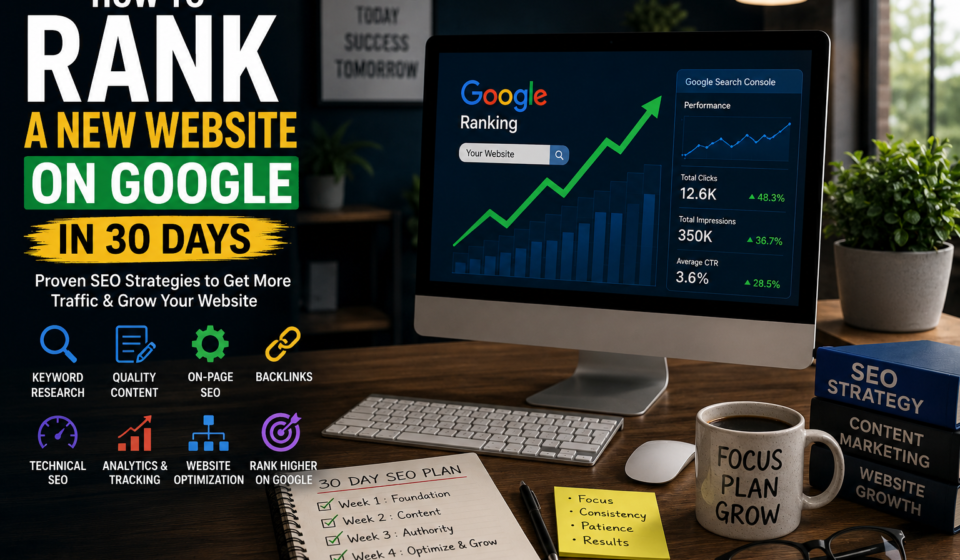

Launching a new website is exciting, but getting visitors from Google is one of the biggest challenges for beginners. Many website owners publish their site, write a few blog posts, and expect traffic to arrive automatically. Unfortunately, that rarely happens. If your goal is to Rank a New Website, you need a clear SEO strategy that follows Google’s best practices.
Google receives billions of searches every day, and every business wants to appear on the first page. However, Google doesn’t rank websites randomly. It evaluates hundreds of ranking factors, including content quality, user experience, website speed, backlinks, mobile usability, and trust.
The good news is that you don’t need a huge marketing budget to Rank a New Website. By following the right SEO techniques consistently, even a brand-new website can begin gaining visibility, attracting organic traffic, and building authority.
In this complete guide, you’ll learn practical steps to Rank a New Website, avoid common SEO mistakes, and build a strong foundation for long-term growth. Whether you own a business website, blog, portfolio, or eCommerce store, these strategies can help you move closer to the first page of Google.Home
Why Is It Difficult to Rank a New Website?
One of the biggest reasons people struggle to Rank a New Website is that Google has very little information about it. Established websites have years of content, backlinks, and user engagement, while a new website starts with almost no authority.
Google wants to provide users with reliable and trustworthy results. Before it starts ranking your pages, it needs to understand:
- What your website is about
- Whether your content is useful
- How visitors interact with your pages
- Whether your website is secure
- How fast your pages load
- Whether other trusted websites recommend you
Because of this, every new website goes through a period where Google gradually evaluates its quality. This is completely normal and should not discourage you.
Instead of looking for shortcuts, focus on building a website that deserves to rank. Consistency is one of the most important factors when trying to Rank a New Website.
Can You Really Rank a New Website Quickly?
Yes—but it depends on several factors.
If you’re targeting low-competition keywords, publishing high-quality content, and following SEO best practices, you can start seeing improvements within a few weeks. Highly competitive keywords, however, may take several months to rank.
To successfully Rank a New Website, focus on realistic goals:
- Get your pages indexed quickly.
- Publish valuable content consistently.
- Target long-tail keywords first.
- Improve technical SEO.
- Build topical authority in one niche.
- Earn quality backlinks over time.
Instead of trying to rank for broad keywords immediately, begin with specific search terms that have lower competition. As your website gains authority, you can target more competitive keywords.
How Google Decides to Rank a New Website
Google uses automated systems to discover, understand, and rank webpages. Understanding this process will help you Rank a New Website more effectively.
Step 1: Crawling
Google’s bots visit your website and discover new pages by following links.
If your website has broken links or poor navigation, important pages may never be discovered.
Step 2: Indexing
After crawling your pages, Google decides whether they should be added to its search index.
Pages with duplicate, thin, or low-quality content may not be indexed.
This is why creating original and valuable content is essential if you want to Rank a New Website.
Step 3: Ranking
Once indexed, Google compares your page with thousands of similar pages.
It evaluates:
- Content quality
- Keyword relevance
- User experience
- Website authority
- Page speed
- Mobile usability
- Backlinks
- Search intent
Only the pages providing the best overall experience appear at the top of search results.
Common Mistakes That Prevent You from Trying to Rank a New Website
Many beginners unknowingly make mistakes that slow down their SEO progress.
1. Publishing Thin Content
Writing 300–400-word articles with little value is unlikely to help you Rank a New Website.
Instead, create detailed, well-structured, and informative content that fully answers the user’s question.
2. Ignoring Keyword Research
Without proper keyword research, you may target phrases that are either too competitive or have no search demand.
Choose keywords with:
- Good search volume
- Low to medium competition
- Clear search intent
This increases your chances to Rank a New Website faster.
3. Slow Website Speed
Visitors expect websites to load quickly.
A slow website can lead to:
- Higher bounce rates
- Poor user experience
- Lower rankings
Improving page speed is one of the easiest ways to support efforts to Rank a New Website.
4. Poor Mobile Experience
Most Google searches now happen on mobile devices.
If your website doesn’t work properly on smartphones, it becomes much harder to Rank a New Website.
Always use a responsive design that provides a smooth experience across all devices.
5. No Internal Linking
Internal links help both users and search engines discover related content.
As you publish more articles, connect them naturally using descriptive anchor text.
This helps distribute authority throughout your website and improves SEO.
Why SEO Is the Best Long-Term Strategy to Rank a New Website
Some businesses rely only on paid advertisements for traffic.
While ads can produce immediate visitors, they stop working as soon as your budget runs out.
SEO works differently.
When you Rank a New Website through SEO, your pages can continue bringing organic traffic for months or even years with regular updates.
Benefits include:
- Sustainable organic traffic
- Better brand visibility
- Higher trust from users
- Lower long-term marketing costs
- Improved user experience
- Better return on investment
SEO requires patience, but the long-term rewards are worth the effort.
What You’ll Learn in This Guide
By the end of this article, you’ll understand how to Rank a New Website using proven SEO strategies.
You’ll learn:
- How keyword research works
- How to optimize your pages
- How technical SEO improves rankings
- How backlinks build authority
- How Google Search Console helps monitor performance
- How to create content that ranks
- A practical 30-day SEO plan
- Common mistakes to avoid
Whether you’re a beginner or a small business owner, these strategies will help you build a strong SEO foundation and increase your chances to Rank a New Website successfully.
On-Page SEO: The Foundation to Rank a New Website
If you want to Rank a New Website, On-Page SEO is one of the first things you should master. On-Page SEO refers to optimizing the content and elements on your website so that search engines can understand your pages and users can easily find the information they need.
Many website owners focus only on publishing content. However, without proper optimization, even great content may struggle to rank. Every page should be designed to help both Google and your visitors.
Let’s explore the most important On-Page SEO techniques that can help you Rank a New Website.
1. Choose the Right Keywords
Keyword research is the first step to Rank a New Website successfully.
A keyword is the phrase people type into Google when searching for information. If you target the wrong keywords, your content may never reach the right audience.
How to Find Good Keywords
Look for keywords that have:
- Medium or high search volume
- Low to medium competition
- Clear search intent
- Relevance to your niche
For example, instead of targeting a broad keyword like SEO, you could target long-tail keywords such as:
- SEO for Small Businesses
- Local SEO Guide
- Technical SEO Checklist
- Rank a New Website
Long-tail keywords are easier to rank for and often bring more qualified visitors.
2. Write High-Quality Content
Google rewards content that genuinely helps users.
If you want to Rank a New Website, your articles should answer questions clearly, provide practical advice, and keep readers engaged.
Characteristics of High-Quality Content
- Original and unique
- Easy to understand
- Well-structured
- Up-to-date
- Helpful and informative
- Backed by examples when possible
Instead of writing short articles, aim to create comprehensive guides that solve the reader’s problem from start to finish.
3. Optimize Your SEO Title
Your SEO title is one of the first things users see in Google search results. A compelling title can improve your click-through rate (CTR), which is an important ranking signal.
Tips for Writing Better SEO Titles
- Place the focus keyword near the beginning.
- Keep the title under 60 characters when possible.
- Include a number or year if relevant.
- Use a power word like Proven, Ultimate, or Effective.
Example:
Rank a New Website: 10 Proven SEO Strategies for 2026
A strong title encourages more people to click on your page.
4. Create an Engaging Meta Description
Although the meta description isn’t a direct ranking factor, it influences whether users click your result.
A good meta description should:
- Include the focus keyword naturally.
- Explain what the article offers.
- Encourage users to click.
- Stay within 150–160 characters.
Example:
Learn how to Rank a New Website using proven SEO strategies, quality content, technical SEO, and Google Search Console.
5. Use Proper Heading Structure
A clear heading hierarchy helps both readers and search engines understand your content.
Recommended Structure
- H1: Main article title (only one per page)
- H2: Main sections
- H3: Subsections
- H4: Additional details (if needed)
Using headings improves readability and makes long articles easier to scan.
6. Optimize Your URL
A clean URL is easier for users to remember and helps search engines understand the topic.
Good URL Example
yourdomain.com/rank-a-new-website
Poor URL Example
yourdomain.com/post?id=34879&page=2
Keep URLs:
- Short
- Descriptive
- Keyword-rich
- Free of unnecessary numbers or symbols
7. Optimize Images for SEO
Images make your content more engaging, but they also need optimization.
Image SEO Checklist
- Use descriptive file names.
- Add ALT text.
- Compress images for faster loading.
- Use modern formats like WebP when possible.
- Match images to the content.
Example ALT Text:
Rank a New Website using SEO strategies
Optimized images improve accessibility and can also appear in Google Images.
8. Build Strong Internal Links
Internal links connect one page of your website to another.
They help:
- Users discover more content.
- Search engines crawl your site.
- Spread page authority.
- Increase time spent on your website.
For example, if you write about keyword research, link it to your article on On-Page SEO or Technical SEO.
As your content library grows, internal linking becomes even more valuable.
9. Improve Readability
Google values content that is easy to read.
To improve readability:
- Write short paragraphs.
- Use bullet points where appropriate.
- Avoid unnecessary jargon.
- Use simple, conversational language.
- Break long sections into smaller headings.
A positive reading experience keeps visitors on your page longer.
10. Match Search Intent
One of the biggest reasons articles fail is because they don’t match what users are actually searching for.
Ask yourself:
- Is the reader looking for information?
- Are they comparing options?
- Do they want a step-by-step guide?
- Are they ready to buy?
When your content matches search intent, Google is more likely to rank it higher.
Content Consistency Helps Rank a New Website
Publishing one article isn’t enough.
If you want to Rank a New Website, create a consistent publishing schedule.
For example:
- Publish one high-quality blog every week.
- Update older articles regularly.
- Link related posts together.
- Focus on one niche before expanding.
Consistency helps build topical authority, making it easier for future articles to rank.
Why Technical SEO Is Essential to Rank a New Website
Many website owners believe that publishing good content is enough to Rank a New Website. While quality content is essential, Google also evaluates the technical health of your website before deciding where it should appear in search results.
Technical SEO ensures that search engines can crawl, index, and understand your website efficiently. If technical issues exist, even excellent content may struggle to rank.
Let’s explore the technical SEO strategies that will help you Rank a New Website and build long-term authority.
1. Set Up Google Search Console
One of the first steps to Rank a New Website is connecting it to Google Search Console.
Google Search Console is a free tool that helps you monitor your website’s performance in Google Search.
Benefits of Google Search Console
- Submit your sitemap
- Request page indexing
- Monitor keyword rankings
- Identify crawl errors
- Check indexing status
- Improve Core Web Vitals
- Find pages with low performance
Checking Search Console every week helps you discover SEO issues before they become major problems.
2. Submit an XML Sitemap
An XML sitemap acts as a roadmap for search engines.
It tells Google which pages are available on your website and should be crawled.
If your goal is to Rank a New Website, always submit your sitemap through Google Search Console.
A Sitemap Helps Google
- Discover new pages faster
- Crawl updated content
- Understand your website structure
- Index pages more efficiently
Whenever you publish new content, make sure your sitemap updates automatically.
3. Optimize Your Robots.txt File
The robots.txt file tells search engine bots which pages they can or cannot crawl.
A poorly configured robots.txt file may accidentally block important pages.
Before trying to Rank a New Website, verify that:
- Important pages are crawlable.
- Admin pages are blocked.
- Duplicate pages are managed properly.
A simple mistake in this file can prevent your content from appearing in Google.
4. Improve Website Speed
Page speed is both a ranking factor and a user experience factor.
Visitors expect websites to load quickly. If your website takes too long, users may leave before reading your content.
Ways to Improve Speed
- Compress images
- Use WebP image format
- Enable browser caching
- Minify CSS and JavaScript
- Remove unused plugins
- Choose reliable hosting
- Use a Content Delivery Network (CDN)
A faster website improves user satisfaction and increases your chances to Rank a New Website.
5. Focus on Core Web Vitals
Core Web Vitals are performance metrics that Google uses to evaluate page experience.
The three key metrics are:
Largest Contentful Paint (LCP)
Measures how quickly the main content loads.
Target: Under 2.5 seconds
Interaction to Next Paint (INP)
Measures how responsive your website is when users interact with it.
Lower response times provide a smoother experience.
Cumulative Layout Shift (CLS)
Measures visual stability.
Avoid unexpected layout changes while the page is loading.
Improving these metrics helps Rank a New Website and provides a better experience for visitors.
6. Make Your Website Mobile-Friendly
More than half of all web traffic comes from mobile devices.
Google primarily uses the mobile version of your website for ranking.
Mobile SEO Checklist
- Responsive design
- Readable text
- Fast loading
- Easy navigation
- Clickable buttons
- Proper image scaling
A mobile-friendly website improves engagement and supports better rankings.
7. Secure Your Website with HTTPS
Website security is another trust signal.
If your website still uses HTTP instead of HTTPS, users may see browser warnings that reduce confidence.
To Rank a New Website, always install an SSL certificate and use HTTPS across every page.
Benefits include:
- Better user trust
- Improved security
- Small SEO advantage
- Safe online transactions
8. Build High-Quality Backlinks
Backlinks remain one of Google’s strongest ranking signals.
A backlink is a link from another website pointing to yours.
When reputable websites link to your content, Google views your website as more trustworthy.
Safe Ways to Build Backlinks
- Publish valuable blog posts
- Guest posting
- Digital PR
- Resource pages
- Industry directories
- Shareable infographics
- Original research
- Case studies
Avoid buying backlinks or participating in spammy link schemes, as these can harm your rankings.
9. Build Topical Authority
Instead of writing about random topics, focus on one niche.
For example, if your website is about digital marketing, create content clusters around:
- SEO
- Google Ads
- Content Marketing
- Social Media Marketing
- Email Marketing
- AI Marketing
- Local SEO
- Website Development
When Google sees consistent expertise in one subject, it becomes easier to Rank a New Website for related keywords.
10. Use Local SEO (If You Serve Local Customers)
If your business targets customers in a specific city or region, Local SEO is essential.
Local SEO Tips
- Create and optimize your Google Business Profile
- Add your business to trusted directories
- Use location-based keywords
- Encourage customer reviews
- Keep your Name, Address, and Phone Number (NAP) consistent
Local SEO can help you attract nearby customers and improve visibility in local search results.
Monitor Your SEO Performance
SEO is not a one-time activity.
To successfully Rank a New Website, track your progress using tools like:
- Google Search Console
- Google Analytics
- PageSpeed Insights
- Keyword tracking tools
Monitor:
- Organic traffic
- Keyword rankings
- Click-through rate (CTR)
- Indexed pages
- Bounce rate
- Conversion rate
Regular analysis helps you identify opportunities for improvement.
Technical SEO Checklist
Before publishing new content, ensure your website has:
- SSL certificate (HTTPS)
- XML sitemap
- Proper robots.txt file
- Mobile-friendly design
- Fast loading speed
- Optimized Core Web Vitals
- Internal linking
- Image optimization
- No broken links
- Structured website architecture
Following this checklist strengthens your website’s technical foundation and supports long-term growth.
30-Day Action Plan to Rank a New Website
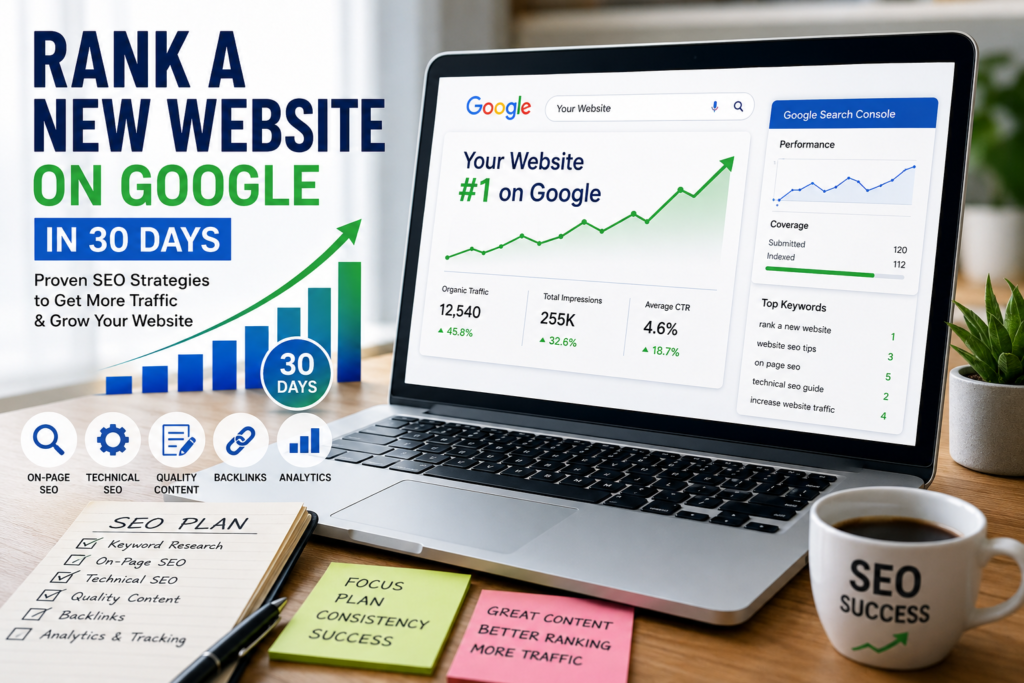
If you want to Rank a New Website, don’t try to do everything at once. A structured plan helps you stay consistent and measure your progress. The following 30-day roadmap is designed for beginners and small businesses that want to build a strong SEO foundation.
Week 1: Build a Strong Foundation
The first week is all about setting up your website correctly.
Complete These Tasks
- Connect your website to Google Search Console.
- Submit your XML sitemap.
- Install Google Analytics.
- Make sure your website uses HTTPS.
- Improve page loading speed.
- Check that your website is mobile-friendly.
- Create a clean website navigation.
- Optimize your homepage for your primary keyword.
A strong foundation makes it much easier to Rank a New Website over the coming weeks.
Week 2: Publish High-Quality Content
Content is one of the biggest ranking factors.
During the second week, focus on publishing valuable articles that answer your audience’s questions.
Content Checklist
- Publish 3–5 in-depth blog posts.
- Target one primary keyword per article.
- Use proper H1, H2, and H3 headings.
- Add optimized images with ALT text.
- Write compelling SEO titles and meta descriptions.
- Link related articles together using internal links.
Remember, quality is always more important than quantity when trying to Rank a New Website.
Week 3: Improve Authority
Google trusts websites that demonstrate expertise and receive recommendations from other reputable websites.
Build Authority By
- Sharing your articles on social media.
- Writing guest posts for relevant blogs.
- Listing your business in trusted directories.
- Earning genuine backlinks.
- Encouraging customer reviews if you run a local business.
Authority grows gradually, but it has a significant impact on your ability to Rank a New Website.
Week 4: Monitor and Optimize
SEO is an ongoing process.
During the fourth week, review your performance and improve what isn’t working.
Check
- Which pages are receiving impressions?
- Which keywords are generating clicks?
- Which pages have high bounce rates?
- Are all important pages indexed?
- Which blog posts need updating?
Use these insights to refine your strategy and continue improving your website.
Common Mistakes That Stop You from Trying to Rank a New Website
Avoiding common SEO mistakes can save you months of frustration.
1. Publishing Content Without Keyword Research
Writing articles without understanding what users are searching for often results in low traffic.
Always research keywords before creating content.
2. Copying Content
Google values original content.
Duplicate or copied articles reduce your chances to Rank a New Website and may even prevent pages from being indexed.
3. Ignoring Technical SEO
Even the best content can struggle if your website has technical problems such as slow loading speed, broken links, or indexing issues.
Perform regular SEO audits to keep your website healthy.
4. Expecting Instant Results
SEO is a long-term investment.
Many website owners give up after a few weeks because they don’t see immediate rankings.
Consistency is the key to successfully Rank a New Website.
5. Publishing Inconsistent Content
Publishing one article every few months isn’t enough.
Create a content calendar and publish valuable content regularly to build topical authority.
Best SEO Practices for 2026
To Rank a New Website, keep these best practices in mind:
- Focus on user intent rather than keyword stuffing.
- Write original, in-depth content.
- Optimize every page for mobile devices.
- Improve Core Web Vitals.
- Update older articles regularly.
- Use internal links strategically.
- Earn high-quality backlinks naturally.
- Monitor performance with Google Search Console and Analytics.
- Stay consistent with your publishing schedule.
These practices align with Google’s goal of providing users with the most helpful and trustworthy information.
Frequently Asked Questions (FAQs)
1. Can I Rank a New Website in 30 Days?
Yes, it’s possible to see initial rankings and impressions within 30 days, especially if you target low-competition keywords and follow SEO best practices. Highly competitive keywords usually take longer.
2. How Many Blog Posts Should I Publish?
Aim for one to two high-quality articles each week. Consistency is more valuable than publishing a large number of low-quality posts.
3. Do Backlinks Still Matter?
Yes. High-quality backlinks remain one of Google’s strongest ranking signals. Focus on earning links naturally through valuable content rather than buying them.
4. Is Google Search Console Necessary?
Absolutely. Google Search Console helps you monitor indexing, keyword performance, crawl errors, and website health. It is an essential tool for anyone trying to Rank a New Website.
5. Should I Focus on SEO or Google Ads?
Both have advantages.
- SEO builds sustainable organic traffic over time.
- Google Ads provides immediate visibility while your SEO efforts grow.
Using both together often delivers the best results.
6. How Often Should I Update My Website?
Review and refresh important articles every 3–6 months. Updating content with new information, statistics, and keywords helps maintain rankings.
Conclusion
Learning how to Rank a New Website is not about finding shortcuts or secret tricks. It requires a combination of valuable content, strong On-Page SEO, solid Technical SEO, quality backlinks, and consistent optimization.
If you focus on helping your audience, publish useful content regularly, improve your website’s technical performance, and monitor your progress, you’ll build a website that earns Google’s trust over time.
Remember that SEO is a marathon, not a sprint. Every article you publish, every page you optimize, and every improvement you make contributes to stronger visibility and long-term organic growth.
The sooner you begin implementing these strategies, the sooner your website can start attracting more visitors, generating leads, and building authority in your niche.
Ready to Rank a New Website?
If you want to Rank a New Website but don’t have the time or expertise to manage SEO yourself, we’re here to help.
Our digital marketing team can assist you with:
- Complete SEO Strategy
- On-Page SEO Optimization
- Technical SEO Audits
- Keyword Research
- Content Marketing
- Google Search Console Setup
- Website Performance Optimization
- Local SEO
- Google Ads Management
Whether you’re launching your first website or looking to improve an existing one, we can help you build a sustainable strategy that drives long-term organic traffic.https://pagespeed.web.dev/
Contact us today for a free SEO consultation and take the first step toward ranking your website on Google.