
In today’s competitive digital landscape, Search Engine Optimization is one of the most effective ways to grow a business online. Every day, millions of people search on Google for products, services, and information. If your website appears on the first page of search results, you have a much better chance of attracting visitors, generating leads, and increasing sales.
Without Search Engine Optimization, even the best-designed website can struggle to gain visibility. Businesses that invest in SEO build long-term organic traffic, improve brand credibility, and reduce their dependence on paid advertising.
Whether you run a small business, an eCommerce store, a startup, or a personal blog, mastering Search Engine Optimization is essential for sustainable online growth.
What is Search Engine Optimization?
Search Engine Optimization (SEO) is the process of improving a website so that it ranks higher in search engine results for relevant keywords. The goal is to attract organic (non-paid) traffic by making your website more useful, trustworthy, and relevant to users.
A successful Search Engine Optimization strategy includes technical improvements, keyword research, high-quality content, on-page optimization, off-page SEO, and continuous performance analysis.
Unlike paid advertising, SEO delivers long-term results because your content continues to attract visitors over time.
Why is Search Engine Optimization Important?
A strong Search Engine Optimization strategy offers several advantages that help businesses grow consistently.
1. Increases Organic Traffic
Most users click on websites that appear on the first page of Google. Search Engine Optimization helps improve your rankings, making it easier for potential customers to find your business.
2. Builds Trust and Credibility
Websites that rank well are often seen as more reliable. Good Search Engine Optimization practices, such as publishing quality content and improving user experience, strengthen your brand’s credibility.
3. Delivers Long-Term Results
Unlike paid campaigns that stop when your budget ends, Search Engine Optimization can continue generating traffic for months or even years if your content remains relevant and updated.
4. Improves User Experience
SEO is not just about search engines. It also focuses on creating a fast, mobile-friendly, and easy-to-navigate website that provides value to visitors.
5. Generates High-Quality Leads
People searching on Google usually have clear intent. A well-planned Search Engine Optimization strategy attracts visitors who are already looking for the products or services you offer.
How Search Engines Work
Understanding how search engines operate helps you build a more effective Search Engine Optimization strategy.
Crawling
Search engine bots discover new web pages by following links across the internet.
Indexing
Once a page is crawled, it is stored in Google’s index, making it eligible to appear in search results.
Ranking
Google evaluates hundreds of factors to determine which pages deserve the top positions. Relevant content, page speed, backlinks, mobile usability, and user experience all influence rankings.
A successful Search Engine Optimization strategy focuses on optimizing each of these areas.
Key Benefits of Search Engine Optimization
Businesses that invest in Search Engine Optimization enjoy many long-term benefits.
Higher Google Rankings
Better optimization increases your chances of appearing on the first page for important keywords.
More Qualified Visitors
SEO attracts users actively searching for solutions, making them more likely to convert into customers.
Better Return on Investment
Although SEO takes time, it often provides one of the highest long-term returns compared to many other marketing channels.
Stronger Brand Visibility
Ranking for multiple keywords increases brand awareness and helps establish authority within your industry.
Sustainable Growth
Unlike temporary marketing campaigns, Search Engine Optimization creates a foundation for continuous online growth.
Types of Search Engine Optimization
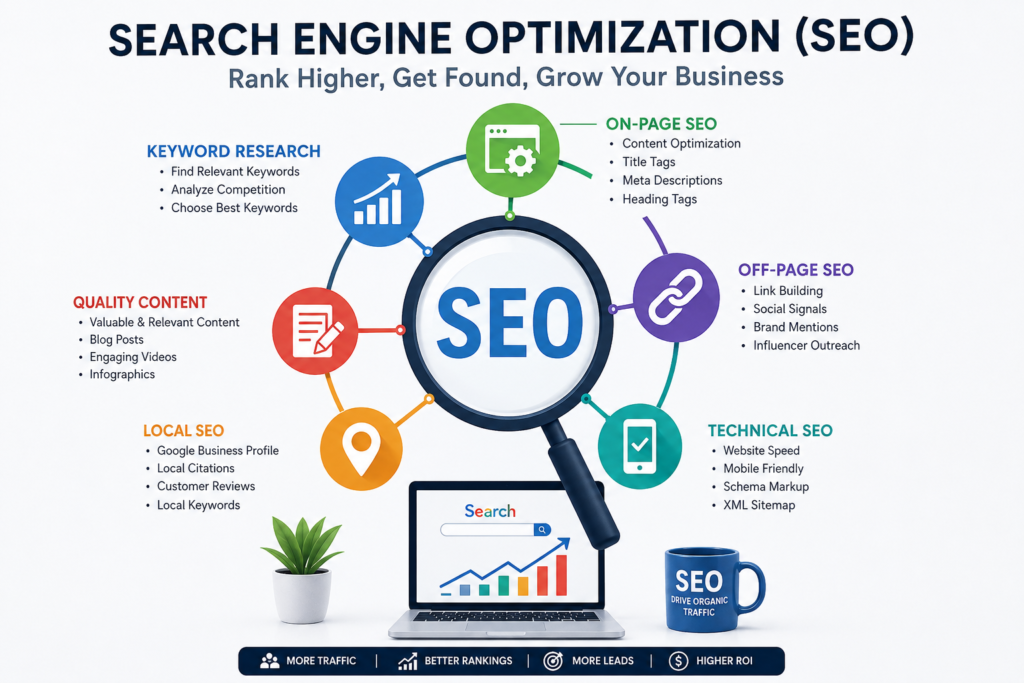
A complete Search Engine Optimization strategy consists of several key areas.
On-Page SEO
On-page SEO focuses on optimizing the elements within your website, including:
- SEO titles
- Meta descriptions
- Headings (H1, H2, H3)
- Keyword placement
- Internal linking
- Image optimization
- URL structure
- Content quality
Off-Page SEO
Off-page SEO improves your website’s authority through activities performed outside your website, such as:
- Link building
- Guest posting
- Brand mentions
- Social sharing
- Digital PR
Technical SEO
Technical SEO ensures that search engines can easily crawl and index your website.
Important technical factors include:
- Website speed
- Mobile responsiveness
- HTTPS security
- XML sitemap
- Robots.txt
- Structured data (Schema)
- Core Web Vitals
Local SEO
Local SEO helps businesses appear in location-based searches and Google Maps results.
It is especially valuable for businesses serving customers in a specific city or region.
Keyword Research: The Foundation of Search Engine Optimization
Every successful Search Engine Optimization campaign begins with keyword research. Without choosing the right keywords, even excellent content may struggle to reach the right audience.
Keyword research helps you understand what users are searching for and how competitive those searches are. It allows you to create content that matches user intent and increases your chances of ranking on Google.
Types of Keywords
A strong strategy should include different keyword types.
Short-Tail Keywords
These are broad keywords with high search volume.
Examples:
- Search Engine Optimization
- SEO
- Digital Marketing
Although they attract more searches, they are also highly competitive.
Long-Tail Keywords
Long-tail keywords are more specific and usually have lower competition.
Examples:
- Search Engine Optimization for Small Business
- Search Engine Optimization Guide for Beginners
- Best Search Engine Optimization Tips in 2026
These keywords often bring visitors with stronger purchase intent and higher conversion rates.
Local Keywords
If your business serves a specific location, local keywords are essential.
Examples:
- SEO Company in Delhi
- Digital Marketing Agency in Mumbai
- Local SEO Services in Bhopal
Including local keywords strengthens your overall Search Engine Optimization strategy and helps attract nearby customers.
Understanding Search Intent
Google’s primary goal is to deliver the most relevant results to users. That’s why understanding search intent is a critical part of Search Engine Optimization.
There are four main types of search intent.
Informational Intent
Users are looking for knowledge or answers.
Examples:
- What is Search Engine Optimization?
- How does SEO work?
Navigational Intent
Users want to visit a specific website.
Examples:
- Google Search Console
- Digital Rohit Blog
Commercial Investigation
Users are researching before making a decision.
Examples:
- Best SEO Tools
- Top SEO Agencies
Transactional Intent
Users are ready to take action or make a purchase.
Examples:
- Buy SEO Services
- Hire SEO Expert
Creating content that matches the user’s search intent improves your Search Engine Optimization performance and increases engagement.
On-Page Search Engine Optimization
On-page SEO refers to optimizing elements within your website to improve rankings and user experience.
Optimize Your SEO Title
The SEO title is one of the most important ranking factors.
Best Practices:
- Include the focus keyword near the beginning.
- Keep the title between 50–60 characters.
- Add power words like “Ultimate,” “Complete,” or “Best.”
- Include the current year if relevant.
Example:
The Ultimate Search Engine Optimization Guide for Beginners (2026)
Write an Effective Meta Description
A compelling meta description encourages users to click on your page.
Tips:
- Keep it between 150–160 characters.
- Include the focus keyword naturally.
- Explain the benefit readers will receive.
- Add a clear call to action.
Use Proper Heading Structure
A well-structured page is easier for both users and search engines to understand.
Recommended format:
- H1: Main title
- H2: Main sections
- H3: Subtopics
- H4: Supporting details (if needed)
Using headings properly improves readability and strengthens Search Engine Optimization.
SEO-Friendly URL Structure
Your page URL should be short, descriptive, and keyword-rich.
Good Example
yourdomain.com/search-engine-optimization-guide
Poor Example
yourdomain.com/post?id=2589&category=seo
Clean URLs improve both user experience and Search Engine Optimization.
Internal Linking Strategy
Internal links connect one page of your website to another.
Benefits include:
- Better website navigation
- Improved crawling by search engines
- Increased page authority
- Longer visitor sessions
- Lower bounce rate
Examples of internal links:
- Complete Google Ads Guide
- Content Marketing Strategy
- Local SEO Checklist
- Technical SEO Guide
An effective internal linking structure strengthens your Search Engine Optimization efforts across your entire website.
Optimize Images for SEO
Images make content more engaging, but they should also be optimized.
Best Practices
- Use descriptive file names.
- Add keyword-rich alt text.
- Compress images for faster loading.
- Use modern formats such as WebP when possible.
- Choose responsive image sizes.
Example Alt Text:
Search Engine Optimization dashboard showing keyword rankings
Image optimization supports accessibility while improving Search Engine Optimization.
Create High-Quality Content
Google rewards content that provides genuine value to readers.
Your content should:
- Answer user questions clearly.
- Include original insights.
- Be easy to read.
- Use short paragraphs.
- Include examples where helpful.
- Stay updated with current information.
Avoid keyword stuffing. Instead, use the focus keyword naturally throughout the article to maintain an approximate 1% density.
Optimize for Featured Snippets
Featured snippets appear at the top of some Google search results and can significantly increase visibility.
To improve your chances:
- Answer common questions directly.
- Use numbered and bulleted lists.
- Include concise definitions.
- Structure content with clear headings.
- Add FAQ sections.
Optimizing for featured snippets is an effective way to enhance your Search Engine Optimization strategy and attract more organic traffic.https://developers.google.com/search/docs/fundamentals/seo-starter-guide
Technical Search Engine Optimization
Technical Search Engine Optimization ensures that search engines can crawl, index, and understand your website efficiently. Even the best content may struggle to rank if technical issues prevent search engines from accessing your pages.
A technically optimized website also provides a better user experience, which is an important ranking factor.
Essential Technical SEO Elements
A strong Search Engine Optimization strategy should include:
- Secure HTTPS website
- XML Sitemap
- Robots.txt optimization
- Clean URL structure
- Mobile responsiveness
- Fast page loading speed
- Schema Markup
- Canonical URLs
- Broken link monitoring
- Crawl error fixes
Regular technical audits help maintain website performance and improve rankings.Services
Core Web Vitals
Core Web Vitals are Google’s user experience metrics that directly influence Search Engine Optimization.
Largest Contentful Paint (LCP)
Measures how quickly the largest visible element loads.
Ideal Score: Under 2.5 seconds.
Interaction to Next Paint (INP)
Measures how quickly your website responds when users interact with it.
A faster response improves user satisfaction and supports Search Engine Optimization.
Cumulative Layout Shift (CLS)
Measures unexpected movement of page elements while loading.
A stable layout creates a better browsing experience and improves SEO performance.
Mobile Search Engine Optimization
More than half of internet users browse websites using smartphones. Google primarily indexes the mobile version of websites, making mobile optimization an essential part of Search Engine Optimization.
Mobile SEO Best Practices
- Responsive website design
- Easy-to-read fonts
- Mobile-friendly navigation
- Fast loading speed
- Optimized images
- Clickable buttons with proper spacing
- Minimal intrusive pop-ups
A mobile-friendly website not only improves rankings but also increases user engagement and conversions.
Website Speed Optimization
Website speed is one of the most important ranking factors in Search Engine Optimization.
Slow websites frustrate visitors and often lead to higher bounce rates.
Improve Website Speed By
- Compressing images
- Using WebP image format
- Enabling browser caching
- Minifying CSS and JavaScript
- Reducing unnecessary plugins
- Choosing reliable web hosting
- Using a Content Delivery Network (CDN)
A fast-loading website improves both user experience and organic rankings.
Off-Page Search Engine Optimization
Off-page Search Engine Optimization focuses on improving your website’s authority through activities outside your website.
Google views backlinks as signals of trust and credibility.
Popular Off-Page SEO Techniques
- Guest Blogging
- Digital PR
- Broken Link Building
- Business Directory Listings
- Social Media Promotion
- Brand Mentions
- Influencer Collaborations
- Content Outreach
Building authority gradually is far more effective than trying to acquire large numbers of low-quality backlinks.
Link Building Strategies
Backlinks remain one of the strongest ranking signals in Search Engine Optimization.
Create High-Quality Content
Useful articles naturally attract backlinks from other websites.
Guest Posting
Writing articles for reputable industry websites helps build authority and earn quality backlinks.
Resource Pages
Reach out to websites that maintain useful resource lists and suggest your valuable content for inclusion.
Broken Link Building
Find broken links on other websites and recommend your relevant content as a replacement.
Digital PR
Publishing original research, case studies, or industry insights can attract backlinks from news websites and blogs.
Remember that quality is always more important than quantity in Search Engine Optimization.
Local Search Engine Optimization
Local SEO helps businesses appear in search results for nearby customers.
If you own a local business, local Search Engine Optimization can generate highly targeted traffic.
Benefits of Local SEO
- More local customers
- Better Google Maps visibility
- Increased phone calls
- Higher foot traffic
- Improved online reputation
Optimize Your Google Business Profile
A well-optimized Google Business Profile is essential for local Search Engine Optimization.
Complete Every Section
Include:
- Business name
- Address
- Phone number
- Website
- Business hours
- Categories
- Services
- High-quality images
Collect Customer Reviews
Positive reviews improve trust and local rankings.
Always respond professionally to both positive and negative reviews.
Publish Regular Updates
Posting offers, announcements, and updates keeps your profile active and improves customer engagement.
Common Search Engine Optimization Mistakes
Many websites fail to rank because of avoidable SEO mistakes.
Keyword Stuffing
Using the focus keyword excessively makes content unnatural and can negatively impact Search Engine Optimization.
Duplicate Content
Publishing copied or repetitive content may reduce your website’s visibility in search results.
Always create original, valuable content.
Ignoring Search Intent
Even well-written content may not rank if it doesn’t answer what users are actually searching for.
Poor Internal Linking
Pages without internal links are harder for both users and search engines to discover.
Connect related articles naturally throughout your website.
Missing Meta Tags
Every important page should have:
- Unique SEO Title
- Meta Description
- H1 Heading
- Optimized URL
Slow Website Performance
A slow website increases bounce rates and negatively affects Search Engine Optimization.
Regularly monitor your website’s speed and performance.
Best SEO Tools for 2026
Using professional tools makes Search Engine Optimization more efficient and data-driven.
Keyword Research Tools
- Google Keyword Planner
- Ahrefs
- SEMrush
- Ubersuggest
Technical SEO Tools
- Google Search Console
- Screaming Frog SEO Spider
- PageSpeed Insights
Analytics Tools
- Google Analytics 4 (GA4)
- Looker Studio
Content Optimization Tools
- Rank Math SEO
- Yoast SEO
- Grammarly
- Surfer SEO
These tools help monitor rankings, identify issues, and continuously improve your SEO performance.