
In today’s competitive world, simply opening a business is no longer enough. Whether you own a local shop, startup, coaching institute, restaurant, gym, clinic, or eCommerce store, your customers are already searching for products and services online. If your business isn’t visible on the internet, you’re likely losing potential customers to competitors every day.
This is where Digital Marketing for Small Business becomes essential. Digital marketing helps small businesses build an online presence, connect with the right audience, generate qualified leads, and increase sales without spending a fortune on traditional advertising.
Unlike newspaper ads, TV commercials, or pamphlets, digital marketing allows you to target the right people at the right time. You can measure every click, track conversions, analyze customer behavior, and optimize campaigns for better results. Even businesses with limited budgets can compete effectively using the right digital marketing strategies.
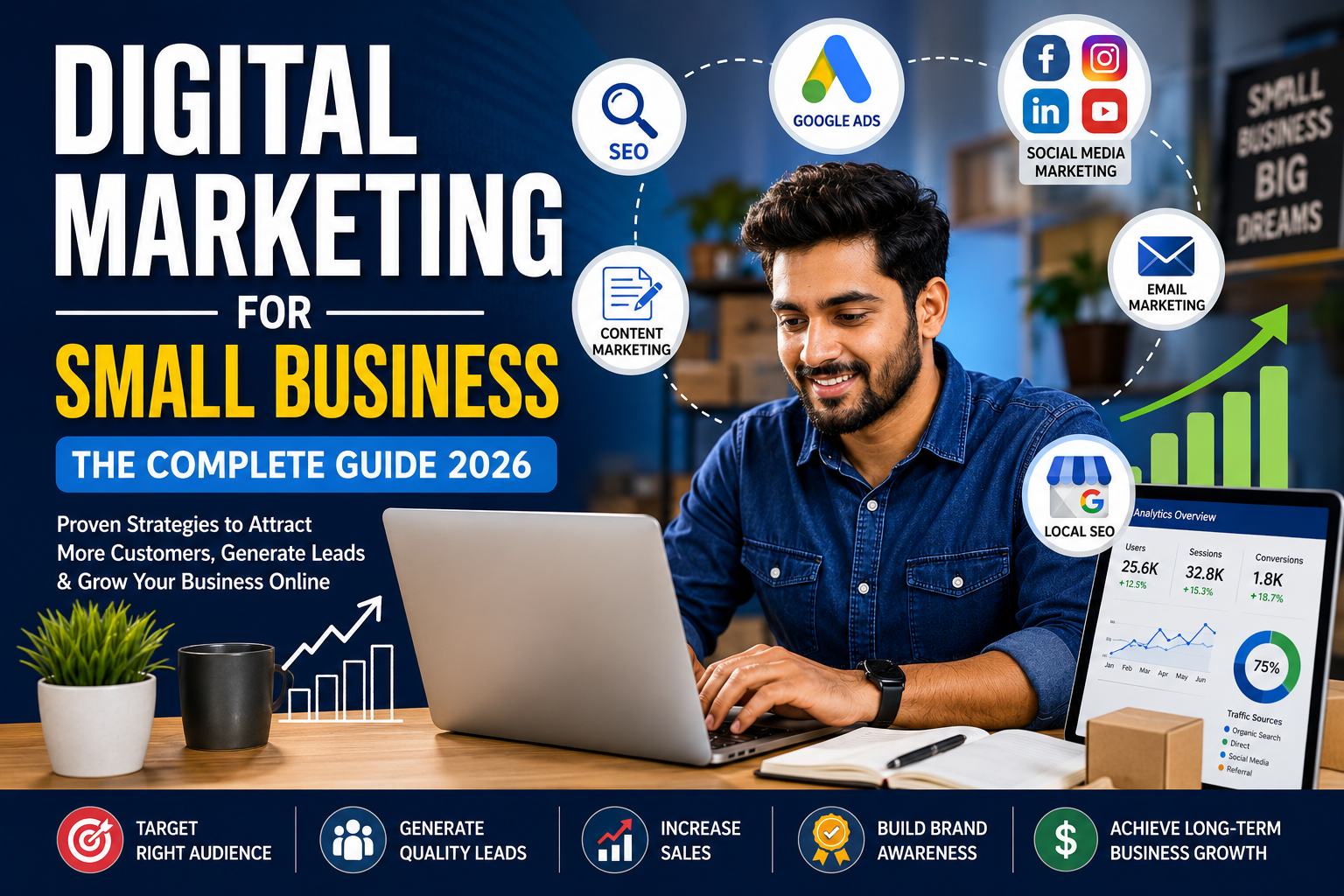
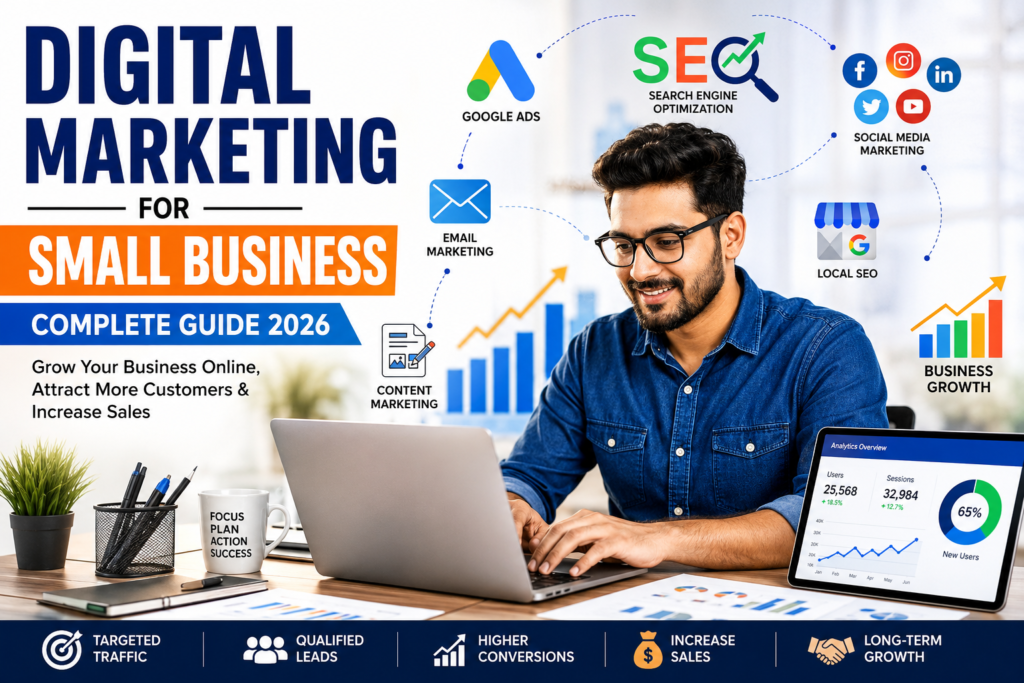
In this comprehensive guide, you’ll learn everything you need to know about Digital Marketing for Small Business, including its benefits, best strategies, SEO, Google Ads, social media marketing, content marketing, email marketing, local SEO, and practical tips to grow your business online.
What is Digital Marketing for Small Business?
Digital Marketing for Small Business refers to using online platforms, websites, search engines, social media, email, and paid advertising to promote products or services and attract potential customers.
Instead of relying only on traditional marketing methods, digital marketing enables businesses to reach their target audience where they spend most of their time—online.
For example:
- A clothing store can use Instagram and Facebook to showcase new collections.
- A coaching institute can run Google Ads to attract students.
- A restaurant can optimize its Google Business Profile to appear in local searches.
- A local service provider can use SEO to rank higher on Google and receive more inquiries.
The main objective of digital marketing is to increase online visibility, generate leads, improve customer engagement, and drive business growth.
Why Every Small Business Needs Digital Marketing
Many small business owners believe digital marketing is only for large companies with huge budgets. This is a common misconception.
Today, even a small business can compete with larger brands by using smart digital marketing strategies.
Here are some reasons why digital marketing is essential:
1. Your Customers Are Online
Millions of people search Google every day before making a purchase. They also spend hours on platforms like YouTube, Instagram, Facebook, and LinkedIn.
If your business is not visible online, potential customers may never discover your products or services.
2. Cost-Effective Marketing
Traditional advertising often requires a significant investment, while digital marketing allows businesses to start with a much smaller budget.
You can:
- Run Google Ads based on your budget.
- Publish free content through blogs.
- Use social media to connect with customers.
- Improve website rankings with SEO.
This makes Digital Marketing for Small Business one of the most affordable marketing methods available.
3. Better Targeting
Unlike traditional marketing, digital marketing allows businesses to target audiences based on:
- Age
- Gender
- Location
- Interests
- Search intent
- Device
- Language
This helps ensure your marketing budget is spent on people who are more likely to become customers.
4. Measurable Results
One of the biggest advantages of digital marketing is that everything can be measured.
You can track:
- Website visitors
- Click-through rates
- Conversion rates
- Cost per lead
- Customer behavior
- Return on investment (ROI)
This data helps businesses improve campaigns and maximize results.
Benefits of Digital Marketing for Small Business
Using Digital Marketing for Small Business offers several long-term benefits that go beyond simply increasing website traffic.
Increased Brand Awareness
A strong online presence helps people recognize and remember your business. Through consistent branding on your website, social media, and search engines, customers become more familiar with your products and services.
More Qualified Leads
Instead of reaching random audiences, digital marketing attracts people who are actively searching for what you offer.
This means:
- Higher conversion rates
- Better quality leads
- Lower advertising costs
Improved Customer Trust
Customers often research businesses online before making a purchase.
A professional website, positive reviews, informative blog posts, and active social media profiles build credibility and trust.
Businesses that consistently provide valuable content are more likely to gain loyal customers.
Higher Sales
When more people discover your business and trust your brand, sales naturally increase.
Digital marketing creates multiple opportunities for customers to interact with your business before making a buying decision.
Better Customer Engagement
Digital marketing enables businesses to communicate directly with customers through:
- Social media
- Live chat
- Email marketing
- Blog comments
This improves relationships and increases customer satisfaction.
Best Digital Marketing Strategies for Small Business
Not every marketing strategy works for every business. The best approach depends on your goals, target audience, and budget.
However, the following strategies consistently deliver excellent results for small businesses.
1. Search Engine Optimization (SEO)
SEO is the process of improving your website so it appears higher in Google search results.
Benefits include:
- Free organic traffic
- Long-term growth
- Increased credibility
- Better user experience
- More qualified leads
SEO remains one of the most valuable investments for any small business.
2. Google Ads
Google Ads allows businesses to appear at the top of search results almost instantly.
It is ideal for:
- New businesses
- Local services
- Seasonal campaigns
- Lead generation
- Product launches
When managed correctly, Google Ads can deliver a strong return on investment.
Social Media Marketing for Small Business
Social media has become one of the most powerful tools in Digital Marketing for Small Business. Platforms like Facebook, Instagram, LinkedIn, YouTube, Pinterest, and X (formerly Twitter) allow businesses to connect directly with potential customers, build trust, and increase brand awareness.
The biggest advantage of social media marketing is that it helps businesses engage with their audience instead of simply promoting products. By consistently posting valuable content, responding to comments, and interacting with followers, you can create a loyal community around your brand.
Benefits of Social Media Marketing
- Increase brand awareness
- Build customer trust
- Generate leads and inquiries
- Drive traffic to your website
- Improve customer engagement
- Promote products and services
- Increase sales
Best Social Media Platforms
Perfect for local businesses, restaurants, coaching institutes, healthcare services, and retail stores. It supports business pages, groups, events, and paid advertising.
Ideal for fashion, beauty, travel, fitness, food, and lifestyle brands. Reels, Stories, and carousel posts can significantly boost engagement.
Best for B2B businesses, consultants, agencies, software companies, and professionals looking to build authority.
YouTube
Video content is one of the fastest-growing forms of digital marketing. Tutorials, product demos, customer testimonials, and educational videos help build credibility and attract organic traffic.
Tips for Effective Social Media Marketing
- Post consistently.
- Use high-quality images and videos.
- Write engaging captions.
- Respond to comments and messages quickly.
- Use relevant hashtags.
- Share customer reviews and success stories.
- Analyze performance and improve your strategy.
Content Marketing
Content Marketing is the foundation of Digital Marketing for Small Business. It focuses on creating valuable, informative, and engaging content that attracts potential customers without directly selling to them.
Instead of pushing advertisements, content marketing educates your audience and builds trust. Over time, this trust often turns visitors into loyal customers.
Types of Content
- Blog articles
- Videos
- Infographics
- Case studies
- eBooks
- Checklists
- Podcasts
- FAQs
- Email newsletters
Why Content Marketing Matters
When people search for solutions on Google, they often find blog posts before they find products. If your content answers their questions, they’re more likely to visit your website and eventually become customers.
For example, a digital marketing agency can publish articles such as:
- How SEO Works
- Google Ads for Beginners
- Social Media Marketing Tips
- Content Marketing Strategy
- Local SEO Guide
These articles attract visitors who are already interested in your services.
Benefits of Content Marketing
- Better Google rankings
- More website traffic
- Increased authority
- Higher conversion rates
- Long-term organic growth
- Improved customer trust
Content Marketing Tips
- Publish high-quality articles regularly.
- Focus on solving customer problems.
- Use your focus keyword naturally.
- Add images, charts, and videos.
- Update old content regularly.
Email Marketing
Email Marketing remains one of the highest ROI strategies in Digital Marketing for Small Business. It allows businesses to communicate directly with customers through personalized emails.
Many people think email marketing is outdated, but it continues to generate excellent results because it reaches customers who have already shown interest in your business.
Benefits of Email Marketing
- Increase repeat sales
- Promote offers
- Share blog posts
- Send newsletters
- Build customer loyalty
- Improve customer retention
Types of Emails
- Welcome Emails
- Promotional Emails
- Product Launch Emails
- Newsletter Emails
- Event Invitations
- Discount Offers
- Follow-Up Emails
Email Marketing Best Practices
- Write compelling subject lines.
- Personalize emails.
- Keep the design clean and mobile-friendly.
- Include a clear call-to-action (CTA).
- Avoid sending too many emails.
- Analyze open rates and click-through rates.
Local SEO for Small Business
If your business serves customers in a specific city or region, Local SEO is one of the most important parts of Digital Marketing for Small Business.
Local SEO helps your business appear in Google Search and Google Maps when people search for services near them.
For example:
- Best Digital Marketing Agency Near Me
- SEO Services in Delhi
- Website Designer Near Me
- Google Ads Expert in Delhi
If your business appears in these searches, you can receive highly targeted local customers.
Benefits of Local SEO
- More local customers
- Better Google Maps visibility
- Increased phone calls
- More website visits
- Higher conversion rates
Google Business Profile Optimization
A Google Business Profile is essential for every local business.
An optimized profile helps customers find:
- Business Name
- Address
- Phone Number
- Website
- Working Hours
- Customer Reviews
- Directions
- Photos
- Services
Optimization Tips
- Complete every section.
- Upload high-quality photos.
- Add business categories.
- Encourage customer reviews.
- Reply to every review.
- Update business hours regularly.
- Publish weekly updates and offers.
A well-optimized Google Business Profile can significantly improve local visibility and customer trust.
Real-Life Example
Imagine two coaching institutes in the same city.
The first institute has:
- No website
- No Google Business Profile
- No social media presence
The second institute has:
- A professional website
- SEO-optimized blog posts
- Active Instagram and Facebook pages
- Google Ads campaigns
- Positive Google reviews
- A fully optimized Google Business Profile
Which one is more likely to receive inquiries from students?
The second institute will almost always attract more customers because it has a stronger digital presence.
This demonstrates why Digital Marketing for Small Business is no longer optional—it’s essential for growth.
Pay-Per-Click (PPC) Advertising
Pay-Per-Click (PPC) advertising is one of the fastest ways to generate traffic and leads. Unlike SEO, which takes time to deliver results, PPC can bring potential customers to your website almost immediately. It is an essential part of Digital Marketing for Small Business, especially for businesses that want quick visibility and measurable results.
With PPC, you only pay when someone clicks on your advertisement. This makes it a cost-effective option because your budget is spent on people who have already shown interest in your products or services.
Popular PPC Platforms
- Google Ads
- Microsoft Advertising (Bing Ads)
- Facebook Ads
- Instagram Ads
- LinkedIn Ads
- YouTube Ads
Benefits of PPC Advertising
- Instant website traffic
- Targeted audience based on location, age, interests, and keywords
- Flexible daily budget
- Fast lead generation
- Easy performance tracking
- High return on investment when campaigns are optimized
PPC Best Practices
- Research the right keywords.
- Write compelling ad headlines.
- Use a strong call-to-action (CTA).
- Send users to a relevant landing page.
- Track conversions regularly.
- Continuously optimize campaigns for better performance.
Video Marketing
Video marketing has become one of the most engaging forms of Digital Marketing for Small Business. People prefer watching videos over reading long blocks of text, making video content an excellent way to educate, entertain, and convert potential customers.
Short-form videos on platforms like YouTube Shorts, Instagram Reels, and Facebook Reels have made it easier for small businesses to reach a wider audience.
Types of Video Content
- Product demonstrations
- Customer testimonials
- Tutorials
- Behind-the-scenes videos
- Educational content
- Frequently Asked Questions (FAQs)
- Company introductions
Benefits of Video Marketing
- Higher engagement
- Better brand awareness
- Increased trust
- Improved conversion rates
- Better SEO performance
- More social media shares
Tips for Creating Effective Videos
- Keep videos short and engaging.
- Focus on solving customer problems.
- Use clear visuals and audio.
- Add subtitles for accessibility.
- Include your website and contact details.
- End with a strong CTA.
Influencer Marketing
Influencer marketing involves collaborating with individuals who have a loyal audience on social media. These influencers promote your products or services to their followers, helping you reach new customers.
For small businesses, working with micro-influencers can often be more affordable and effective than partnering with celebrities.
Benefits
- Increased brand awareness
- Higher customer trust
- Better engagement
- Faster audience growth
- Improved sales
Choosing the Right Influencer
- Relevant audience
- Good engagement rate
- Authentic content
- Positive reputation
- Transparent collaborations
Common Digital Marketing Mistakes to Avoid
Many small businesses invest in digital marketing but fail to achieve results because they make avoidable mistakes.
1. Ignoring SEO
Without SEO, your website may struggle to appear in Google search results, reducing your chances of attracting organic traffic.
2. Not Having a Mobile-Friendly Website
Most users browse the internet on smartphones. A slow or poorly designed mobile website can lead to high bounce rates and lost customers.
3. Inconsistent Posting on Social Media
Posting once a month is unlikely to build a strong online presence. Consistency helps keep your audience engaged.
4. Ignoring Analytics
Tools like Google Analytics and Google Search Console provide valuable insights into website performance. Businesses that ignore analytics miss opportunities for improvement.
5. Targeting Everyone
Trying to market to everyone usually results in poor performance. Define your ideal customer and create campaigns specifically for that audience.
6. Weak Call-to-Action
Every blog, landing page, or advertisement should encourage visitors to take action, such as:
- Contact Us
- Get a Free Quote
- Book a Consultation
- Download a Guide
- Subscribe to Our Newsletter
Best Digital Marketing Tools for Small Businesses
Using the right tools can save time, improve efficiency, and deliver better results.
SEO Tools
- Google Search Console
- Google Keyword Planner
- Ahrefs
- SEMrush
- Ubersuggest
Analytics Tools
- Google Analytics
- Microsoft Clarity
Social Media Tools
- Buffer
- Hootsuite
- Meta Business Suite
Email Marketing Tools
- Mailchimp
- Brevo
- ConvertKit
Graphic Design Tools
- Canva
- Adobe Express
Website Tools
- WordPress
- Elementor
Future Trends in Digital Marketing for Small Business
Digital marketing is constantly evolving. Staying updated with the latest trends can help your business remain competitive.
Artificial Intelligence (AI)
AI is transforming content creation, customer support, and marketing automation. Businesses can use AI tools to improve productivity and personalize customer experiences.
Voice Search Optimization
With the growing use of voice assistants, optimizing your content for conversational search queries is becoming increasingly important.
Short-Form Video Content
Platforms like YouTube Shorts and Instagram Reels continue to dominate user engagement. Businesses should invest in creating informative and entertaining short videos.
Personalization
Customers expect personalized experiences. Tailoring emails, offers, and website content based on user behavior can improve engagement and conversions.
First-Party Data
As privacy regulations evolve, collecting and using first-party customer data responsibly will become even more valuable for marketers.https://digitalrohit.online/services/
Expert Tips to Grow Your Small Business Online
- Build a professional, fast-loading website.
- Publish helpful blog content regularly.
- Optimize every page for SEO.
- Claim and optimize your Google Business Profile.
- Be active on the social media platforms your audience uses.
- Use Google Ads for quick lead generation.
- Collect customer reviews and testimonials.
- Track your marketing performance and refine your strategy.
- Focus on providing value before selling.
- Stay updated with the latest digital marketing trendshttps://ayusshdigital.online/home/
Frequently Asked Questions (FAQs)
1. What is Digital Marketing for Small Business?
Digital Marketing for Small Business is the process of promoting a business online using channels like SEO, Google Ads, social media, email marketing, content marketing, and websites. It helps small businesses reach more customers, increase brand awareness, and generate quality leads.
2. Why is digital marketing important for small businesses?
Digital marketing is important because it allows small businesses to compete with larger brands at a lower cost. It helps attract targeted customers, improve online visibility, and measure campaign performance in real time.
3. Which digital marketing strategy is best for small businesses?
There is no single best strategy. A combination of SEO, Google Ads, Local SEO, Social Media Marketing, Content Marketing, and Email Marketing usually delivers the best long-term results.
4. How much should a small business spend on digital marketing?
The budget depends on your business goals and competition. Many small businesses start with ₹10,000–₹50,000 per month and increase their investment as they grow.
5. How long does SEO take to show results?
SEO is a long-term strategy. Most websites start seeing noticeable improvements within 3 to 6 months, while competitive industries may take longer.
6. Is Google Ads better than SEO?
Both have different advantages. Google Ads provides immediate visibility and leads, while SEO builds sustainable organic traffic over time. Using both together often produces the best results.
7. What is Local SEO?
Local SEO focuses on improving your visibility in location-based searches, such as “digital marketing agency near me” or “SEO services in Delhi.” It helps nearby customers find your business more easily.
8. Can social media marketing increase sales?
Yes. Consistent social media marketing helps build trust, engage your audience, showcase products or services, and drive traffic to your website, leading to increased sales.
9. Why is content marketing important?
Content marketing attracts visitors by answering their questions and solving their problems. High-quality blog posts, videos, and guides improve SEO, build authority, and generate qualified leads.
10. How can I measure digital marketing success?
You can measure success using key metrics such as:
- Website traffic
- Lead generation
- Conversion rate
- Cost per lead (CPL)
- Return on Investment (ROI)
- Keyword rankings
- Social media engagement
- Email open and click rates
Key Takeaways
- Digital Marketing for Small Business is essential for long-term growth.
- Build a professional, mobile-friendly website.
- Invest in SEO for sustainable traffic.
- Use Google Ads for quick lead generation.
- Optimize your Google Business Profile for local customers.
- Publish valuable content regularly.
- Stay active on social media.
- Build an email list to nurture customers.
- Track performance with analytics tools.
- Keep learning and adapting to new trends.
Conclusion
In today’s digital world, having a strong online presence is no longer optional—it’s essential. Whether you run a local shop, startup, coaching institute, restaurant, clinic, or eCommerce business, Digital Marketing for Small Business can help you reach the right audience, build trust, generate quality leads, and increase sales.
Success doesn’t happen overnight. It comes from consistently applying proven strategies such as SEO, Google Ads, social media marketing, content marketing, email marketing, and Local SEO. By understanding your audience, creating valuable content, and monitoring your performance, you can build a sustainable online presence that supports long-term business growth.
Start with one or two strategies, measure the results, and gradually expand your digital marketing efforts. The businesses that adapt to changing customer behavior and invest in digital channels today will be better positioned for success in the future.
Call to Action (CTA)
Ready to grow your business online?
At Digital Rohit, we help small businesses achieve real results through:
- Search Engine Optimization (SEO)
- Google Ads Management
- Social Media Marketing
- Website Design & Development
- Content Marketing
- Local SEO
- YouTube Marketing
Contact us today for a free consultation and discover how the right digital marketing strategy can grow your business.